A Guide to Winning at Antique Watch Auctions
Discover how to navigate antique watch auctions with confidence. Learn expert strategies for bidding, consigning, and verifying your next timepiece.
StolenWatch Team
Watch Authentication Specialist at StolenWatch
Discover how to navigate antique watch auctions with confidence. Learn expert strategies for bidding, consigning, and verifying your next timepiece.
Antique watch auctions are more than just a place to buy old timepieces; they're curated events where rare, vintage, and historically important watches find new homes. Think of them as the ultimate marketplace connecting serious collectors with incredible finds. In many ways, these auctions are a pulse check for the entire luxury watch world, a place where history, artistry, and investment all come together with the slam of a gavel.
Entering the World of Antique Watch Auctions
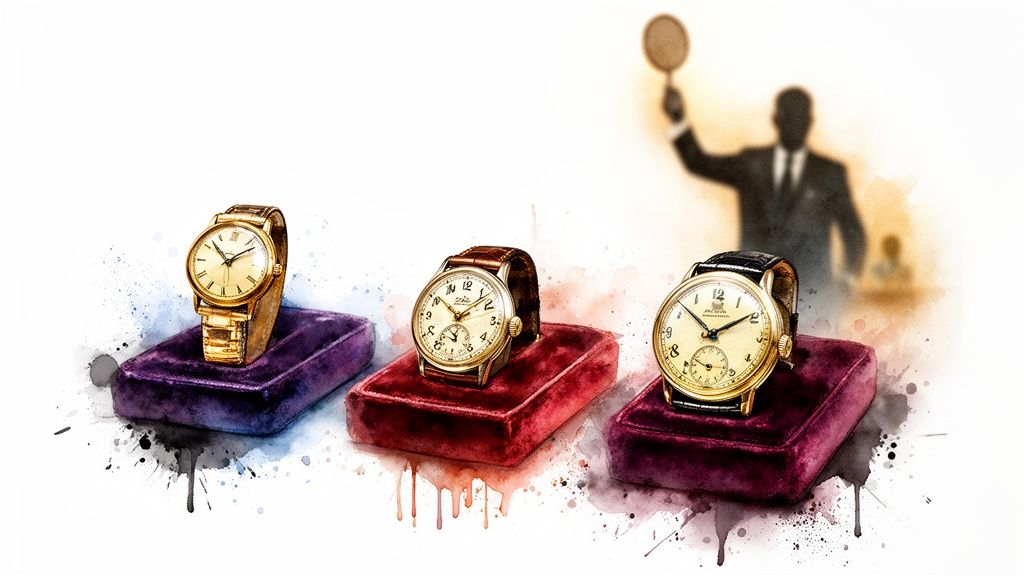 Three vintage gold watches displayed on velvet cushions at an auction with an auctioneer in the background.
Welcome to the high-stakes, thrilling arena of horological sales. An antique watch auction isn't a simple transaction; it's a meticulously organized treasure hunt. Each sale presents a new collection of mechanical marvels, giving you a shot at owning pieces you just can't find anywhere else—watches with incredible stories that are long out of production. This guide will be your map for navigating it all.
We're here to pull back the curtain on the whole process, making it feel less intimidating whether you're a seasoned collector, a first-timer, or someone looking to sell a prized watch. We'll break down the roles of the big-name auction houses, the enthusiastic bidders, and the sellers who entrust their timepieces to the sale. The auction house is the trusted middleman, handling everything from authenticating and cataloging the watch to showcasing it to buyers around the globe.
Understanding the Key Players
At its heart, the auction world revolves around three main groups of people, each with their own goals. Getting a handle on who does what is the first step to feeling comfortable in this environment.
- The Consignor (Seller): This is the person or estate who owns the watch. They hand it over to an auction house with one clear goal: to get the best possible price for it.
- The Auction House: This is the team of experts who manage the sale from start to finish. They evaluate the watch, market it, and run the auction itself, earning a commission from both the buyer (the buyer's premium) and the seller.
- The Bidder (Buyer): This is you—the collector or investor looking to add a new piece to your collection. You're competing with others to win the watch, hopefully at a fair price.
This guide will give you the inside track on how to navigate this dynamic. You'll learn the secrets to placing a winning bid without getting carried away, and more importantly, the critical steps to ensure the watch you're about to buy has a clean and verifiable past.
The true art of the auction is not just in winning the bid, but in knowing you've secured a legitimate piece of history. Provenance and due diligence are the collector's most valuable tools, protecting both their investment and the integrity of their collection.
Ultimately, we want to arm you with the knowledge to step into the auction world with confidence. When you understand the rules of the game and the absolute necessity of verification, you can protect your money, sidestep major pitfalls like accidentally buying a stolen watch, and build a collection that's valuable in more ways than one.
Getting a Feel for the Auction Landscape
<iframe width="100%" style="aspect-ratio: 16 / 9;" src="https://www.youtube.com/embed/xoQR0f2aarA" frameborder="0" allow="autoplay; encrypted-media" allowfullscreen></iframe>Before you can confidently place a bid, you have to get a feel for the world you're stepping into. The antique watch auction market isn't just one big marketplace; it’s a whole ecosystem with different venues, powerful players, and its own set of financial rules. Knowing where to look and who to trust is half the battle.
Broadly speaking, you'll encounter two main types of auctions: the classic, high-energy live events and the online sales that have become incredibly popular. The live auctions, often held in places like Geneva or Hong Kong, are an experience in themselves. There's an electric atmosphere as you inspect the watches in person and feel the bidding tension build in the room. Online auctions, on the other hand, throw the doors open to everyone, letting you bid on a rare Patek Philippe from your living room.
The Big Three: Who Runs the Show?
When you look at the top tier of the auction world, a few prestigious houses stand out. These aren't just selling platforms; they're the gatekeepers of watchmaking history, curating sales that can make or break the market for certain models. While countless smaller, reputable auctioneers operate worldwide, three names consistently grab the headlines.
Here’s a quick look at the major players and what sets them apart.
Top Antique Watch Auction Houses at a Glance
| Auction House | Specialty | Typical Buyer's Premium | Known For |
|---|---|---|---|
| Phillips | High-end, ultra-rare vintage and modern collectibles. | ~26% | Record-shattering prices for icons like the Paul Newman Daytona. They have a Midas touch. |
| Christie's | Broad spectrum, from accessible vintage to museum-quality historical pieces. | ~26% | Centuries of experience in luxury goods. Their sales feel like a trip through horological history. |
| Sotheby's | Diverse catalogs with a strong global presence; often features unique thematic sales. | ~26% | Deep expertise and a knack for unearthing watches with fascinating stories and provenance. |
Getting to know these houses is key. Their catalogs are a masterclass in what's desirable, and following their results is the best way to understand market trends. You can find more discussions about what's happening in the broader watch market on our blog.
Don't Forget the Fees: Understanding the Buyer's Premium
Here’s one of the most critical—and often overlooked—details for any new bidder: the buyer's premium. This is a fee, calculated as a percentage, that the auction house adds on top of the final price your bid wins at (the "hammer price"). It’s essentially their commission for sourcing, vetting, marketing, and hosting the sale.
The hammer price is not your final price. Forgetting to factor in the buyer's premium is one of the most common and costly mistakes a new bidder can make. Always calculate your maximum bid with this fee already included.
Let's break it down. Say a watch has a hammer price of $8,000. If the buyer's premium is 25%, you're on the hook for another $2,000. Your total cost, before any taxes or shipping, jumps to $10,000. This fee typically falls somewhere between 20% and 26%, depending on the auction house and the final value of the watch.
This fee structure is the engine that runs the auction world, funding the expertise and global network that bring these incredible timepieces to market. And what a market it is. The global watch auction scene has exploded into a multi-billion-dollar powerhouse, fueled by incredible collector demand. In a recent year, total sales hit a staggering USD 3.12 billion, a clear sign that antique watches are commanding serious prices for their rarity and history. For a deeper dive, you can check out the full watch auction market report.
Once you get these financial mechanics down, you can bid with confidence, knowing exactly what you'll owe when that final invoice arrives.
A Seller's Guide to Consigning a Timepiece
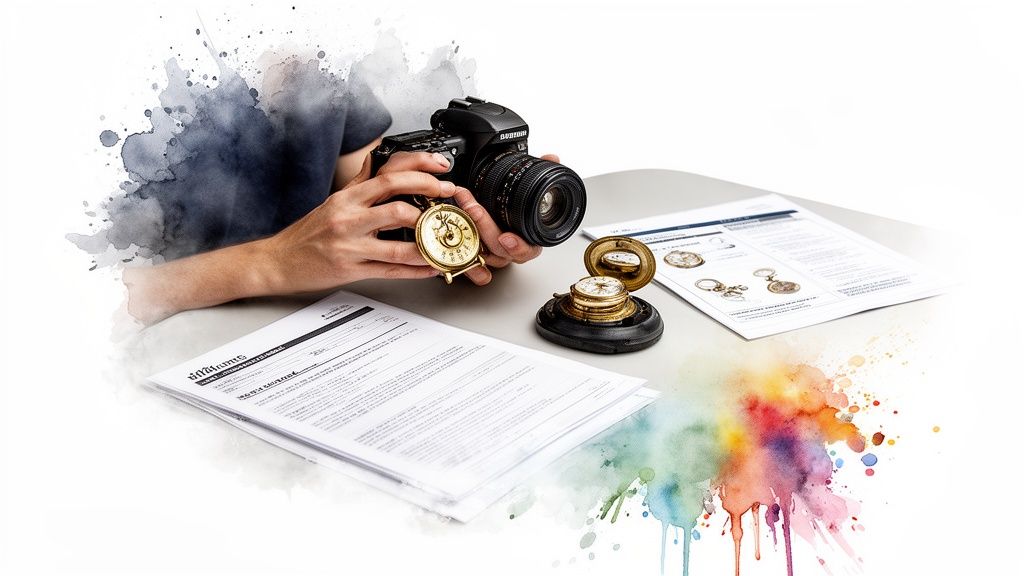 Person holding a camera to photograph antique gold pocket watches and documents on a table.
If you've decided it's time to sell an antique watch, consigning it to an auction house is one of the smartest moves you can make. It puts your timepiece in front of a global audience of serious, vetted collectors who are ready to buy. Think of the auction house as your partner in the sale; they succeed when you succeed, and their job is to make your watch shine.
The entire journey kicks off with a professional valuation. You'll bring your watch to their specialists, who will meticulously examine its condition, rarity, historical significance, and current market demand. This initial estimate is more than just a number—it’s the foundation for setting the auction reserve (the confidential minimum price you’ll accept) and the public estimate you'll see in the catalog. Getting this right is the first, and arguably most important, step.
Decoding the Consignment Agreement
Once you and the auction house see eye-to-eye on an estimate, it's time for the paperwork: the consignment agreement. This is a legally binding contract, so it’s critical to read and understand every single clause before you sign. Don't just skim it. This document spells out exactly what you'll pay and what the auction house promises to do for you.
Be sure to focus on these key financial details:
- Seller's Commission: This is the auction house's cut, calculated as a percentage of the final "hammer price." This fee is often negotiable, especially if you're consigning a particularly rare or high-value piece.
- Marketing and Photography Fees: Presenting a watch beautifully isn't optional. Some houses will charge flat fees for professional photography, catalog placement, and broader marketing campaigns to promote the sale.
- Insurance and Loss/Damage Liability: The agreement should clearly state that your watch is insured from the moment it's in their possession. Double-check the coverage details so you have peace of mind that your asset is protected.
Think of this agreement as the playbook for the sale. A clear understanding of these terms means no unwelcome surprises when the final payout arrives after a successful auction.
Maximizing Value Through Presentation and Provenance
With the contract signed, the auction house team gets to work. Their real skill lies in building a compelling story around your watch. This is done through two key elements: world-class photography and a detailed, evocative catalog description. Professional photos will capture every detail, from the warm patina on the dial to the fine finishing on the movement that’s only visible through a loupe.
The description, however, is where the magic really happens. It moves beyond the basic specs to weave a narrative about what makes your watch special. This is where provenance becomes your most powerful tool.
Provenance is the documented life story of a timepiece. The original box and papers, old service records, and even photos of a past owner wearing it can dramatically increase a watch's value—sometimes by 20-30% or even more.
This paper trail offers undeniable proof of authenticity and creates a tangible link to the past that collectors at auction absolutely live for. It elevates your watch from a beautiful object to a historical artifact. For instance, a vintage Rolex Submariner with its original warranty papers and sales receipt is in a completely different league than the exact same model without them.
By giving the auction house every scrap of documentation you have, you're arming them with the best tools to build the strongest possible case for your watch. This rich history, combined with their marketing expertise, is what attracts the most determined bidders and creates the competitive buzz needed to drive up the price on auction day.
The Buyer's Playbook for Due Diligence and Bidding
Winning at an antique watch auction isn't just about having the deepest pockets. It's about having the sharpest strategy. Your success is built on a foundation of meticulous research you do long before you ever raise a paddle, and this playbook is your guide to navigating the process safely, from initial inspection to the final, winning bid.
Think of yourself as a detective. The first and most crucial phase is due diligence, and your mission is to uncover every last detail about the watch you're targeting. Whether you're examining it in person at a preview event or poring over a detailed online condition report, you need to have a critical eye.
Don't just glance at the overall appearance. Scrutinize the dial for any hint of a refinishing job, check the case for the soft, rounded edges that signal over-polishing, and assess the movement for any non-original parts. These are the details that separate an authentic treasure from a costly mistake and ultimately determine its true value.
Setting Your Sights and Your Budget
Once you've given the watch a thorough once-over, you need to get a handle on its fair market value. Going in blind is the fastest way to overpay. Start by digging into recent auction results for comparable models from major houses like Phillips, Christie’s, and Sotheby’s. This data gives you a real-world benchmark for what people are actually paying.
Remember to factor in the nuances of condition, rarity, and provenance. A watch with its original box and papers will always fetch a premium over a "naked" one. After you’ve done your homework, set a firm maximum bid—the absolute highest price you are willing to pay, buyer's premium included.
Your maximum bid is your most important tool for emotional discipline. Set it based on logic and research before the auction starts, and stick to it no matter how intense the bidding gets.
This number is your anchor in the storm. It stops you from getting swept up in the heat of the moment and making a decision you'll regret. The thrill of a bidding war is real, but your budget has to be non-negotiable.
The Critical Serial Number Check
Beyond assessing the watch's condition and market value lies the most important check of all: verifying its history to make sure it isn’t stolen. A beautiful timepiece with a tainted past isn't just worthless; it's a legal nightmare waiting to happen. This is where a quick serial number check becomes an absolutely essential part of your due diligence.
This is the online search page for StolenWatch, a database designed to help buyers instantly verify a watch's status.
The tool is straightforward: you enter the brand and serial number, and it instantly scans its records to see if the watch has been reported stolen. This single step can save you from a world of financial loss and legal trouble.
The risks have never been higher. As the pre-owned market has exploded, stolen antiques can easily slip into secondary channels where ownership history gets murky. A recent auction dedicated to neo-vintage watches saw all 65 lots sell for a staggering CHF 24.8 million (USD 28.5 million). Experts warn that sales of this magnitude are a magnet for criminal activity. Platforms offering instant serial checks are a massive help, allowing buyers to flag hot items before the bidding even starts. You can learn more about the growth and risks in the pre-owned market from recent industry analysis.
Mastering Your Bidding Strategy
With your research done and your max price locked in, it’s time to think about tactics. First, get familiar with the auction's structure. Most sales follow a system of bid increments, which are the pre-set amounts the bidding has to increase by.
Here’s a common bid increment structure you might run into:
| Price Range | Bid Increment |
|---|---|
| $1,000 - $5,000 | $100 |
| $5,000 - $10,000 | $250 |
| $10,000 - $20,000 | $500 |
| $20,000+ | $1,000 |
Knowing these steps lets you plan your bids instead of just reacting. For instance, if the bidding is at $10,250 and you want in, your next bid has to be at least $10,500. A smart bidder is always thinking one or two increments ahead.
When the auction kicks off, keep a cool head. Watch the action closely and place your bids with confidence. A popular strategy is to hang back until the bidding slows, then jump in—a move that can sometimes unnerve less committed bidders. Another approach is the "power bid," where you open with your absolute maximum right away to signal serious intent.
Ultimately, the best strategy is the one that fits your personality and your budget. By pairing exhaustive due diligence with a disciplined bidding plan, you'll transform from a hopeful spectator into a strategic buyer, fully prepared to acquire a legitimate piece of watchmaking history at a fair price.
How to Verify Provenance and Spot Stolen Watches
The thrill of chasing a rare timepiece at auction is undeniable, but it comes with a serious responsibility. Beneath the excitement lies a hidden risk: a watch’s history, or provenance, is its most valuable asset, yet it's also where fraud and theft can hide in plain sight. Buying a stolen watch, even unknowingly, can mean a total financial loss and a world of legal headaches.
Think of this as your pre-flight checklist for navigating the auction world safely. We’ll walk through how to scrutinize a watch’s backstory—from its papers to its service history—and how to use modern tools to flag stolen items before you even think about placing a bid.
The Paper Trail Is Your First Line of Defense
An antique watch shouldn't be a lone traveler through time. It ought to have a collection of documents that trace its journey, and this "paper trail" is your first and most powerful tool for confirming its authenticity and legitimate ownership.
When you're looking at a watch at auction, don't be shy. Insist on seeing and inspecting these key documents:
- Original Box and Papers: This is the absolute gold standard. The original warranty card or certificate, stamped by an authorized dealer with the sale date, is concrete proof of where the watch started its life.
- Service Records: Receipts from official service centers or respected watchmakers create a timeline. They show the watch has been cared for and help confirm its history isn't fabricated.
- Archival Extracts: For very old or significant pieces, you can often get an "Extract from the Archives" directly from the manufacturer. This document confirms the watch's production details, linking its serial number directly to when and where it was first sold.
Each piece of paper adds another layer of confidence. If a high-value vintage watch has no paperwork at all, that’s not just a minor detail—it's a massive red flag that demands a much deeper investigation.
A watch without its story is just an object. A watch with verifiable provenance is a piece of history. The difference in value—and security—is immense.
The intense demand for these historical pieces has, unfortunately, created a dangerous market. With active watch theft and an estimated 40 million fakes floating around globally, auction integrity is under constant threat. As data from sites like WatchGecko.com shows the risks in the secondary watch market, it's clear that once an unverified watch is sold, it can easily vanish into a private collection, making recovery next to impossible.
Using a Stolen Watch Database for Instant Verification
Even if a watch has pristine papers, there’s one final, crucial check to make. A watch could have been stolen from its rightful owner years after it was first sold. This is where a dedicated stolen watch database becomes your indispensable secret weapon.
These platforms let you search a watch's serial number against a global registry of reported thefts. It’s a simple process with powerful results. Before you bid, get the serial number from the auction house—any reputable house will provide it—and run the check.
This decision tree gives you a visual map of the key steps every buyer should take to stay safe, from the initial inspection right through to the final verification.
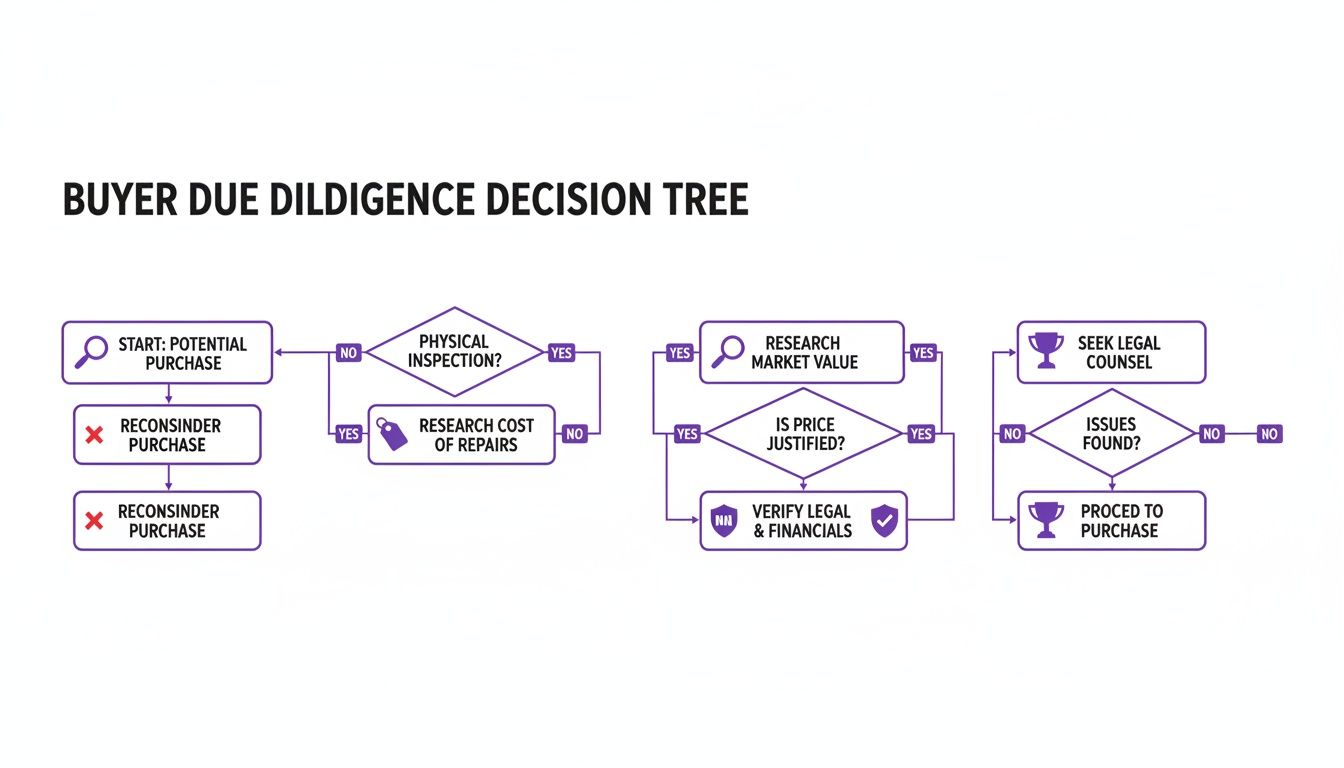 A flowchart titled 'Buyer Due Diligence Decision Tree' outlines steps from potential purchase to legal verification.
As the flowchart shows, this verification step is the final, non-negotiable gate you must pass through before committing to a bid.
Reading the results is simple:
- Clear Result: No matches found. This is a great sign that the watch hasn't been reported stolen on that particular database.
- Flagged Result: The serial number gets a hit. Stop immediately. Politely let the auction house know what you found, and walk away. No deal is worth the risk.
This check gives you a layer of security that papers alone just can't provide. If you're curious about how different services work, you can explore this comparison of StolenWatch vs The Watch Register.
Stolen Watch Red Flag Checklist
To help you spot trouble quickly, here's a checklist to use during your due diligence. One red flag doesn't automatically mean a watch is stolen, but it’s a clear signal to hit the brakes and investigate further.
| Red Flag | What It Means | Recommended Action |
|---|---|---|
| No Box or Papers | The watch's original identity and ownership history are completely unverified. | Ask for an archival extract from the maker. If no history can be proven, be ready to walk away. |
| Heavily Polished Serial Number | The engravings may have been deliberately buffed down to hide the watch's true identity. | Avoid it. This is one of the most serious warning signs of a stolen or cobbled-together piece. |
| Auction House Hesitates | They are reluctant to give you the serial number or provide clear photos of the engravings. | A transparent auction house has nothing to hide. Hesitation is a major red flag about the watch or their own process. |
| Price Is Too Good To Be True | An unusually low estimate could mean a seller is desperate to offload a problem watch. | Research what comparable models have sold for. Ask the specialist directly why the valuation is so low. |
This isn't about being paranoid; it's about being smart. By combining a meticulous review of the paper trail with a definitive serial number check, you arm yourself with the best defense possible. This diligent approach lets you participate in antique watch auctions with confidence, knowing every piece you bid on is the real deal.
So, You Won (or Sold) the Watch. What Now?
The final bang of the gavel isn't the end of the story—it's just the beginning of the final chapter. Whether you’re the thrilled new owner of a vintage timepiece or the seller waiting on the results, a clear process kicks in to finalize everything. Getting this part right is key to a smooth and secure handover.
For the Winning Bidder: Payment and Collection
Your first piece of mail after the auction will be the invoice. It'll break down the total you owe, which includes the hammer price (the winning bid), the buyer’s premium (the auction house's fee), and any local taxes. Auction houses usually expect payment pretty quickly, often within 7 to 10 days, and a wire transfer is the most common method.
Once your payment is confirmed, it's time to get your watch.
Getting Your Timepiece Home Safely
You’ve got two main options here: pick it up yourself or have it shipped. Collecting it in person is a great idea if you can swing it, as it gives you one last chance to look everything over before you leave.
If you’re having it shipped, don’t skimp. Always use the fully insured, specialized courier recommended by the auction house. This is a critical moment for a valuable, and often irreplaceable, piece. Cutting corners on shipping is a risk you just don't want to take.
The second that watch is legally yours, its safety is on you.
Your first phone call after arranging pickup or delivery shouldn't be to brag to a friend—it should be to your insurance agent. Get that new watch added to your policy immediately to cover it for theft, loss, or damage.
For the Seller: The Payout Process
If you consigned the watch, this is the part where you wait for the settlement. The auction house will let you know the final hammer price. Once they've received and cleared the buyer’s payment, they’ll calculate your payout. This is simply the hammer price minus the seller’s commission you agreed to and any other fees for things like photography or insurance.
You can typically expect the funds to land in your account about 30 to 45 days after the auction date.
But what if your watch didn't find a new home? If a lot doesn't meet its reserve price, it's considered "bought-in." At this point, the auction specialist will walk you through your options. You can either re-list it in a future sale (often with adjusted estimates) or have it returned. Even if the sale didn’t go as planned, you’ll have a clear path forward.
A Few Common Questions About Watch Auctions
Getting into the world of antique watch auctions always brings up a few key questions. Whether you're a seasoned collector or just starting out, here are some straightforward answers to the things people ask most, designed to help you feel more confident when you're ready to bid.
What Exactly Is a Buyer’s Premium?
Think of the buyer’s premium as the auction house's service fee. It's an extra charge the winning bidder pays on top of the final "hammer price"—the price the watch sold for in the room.
This fee is how the auction house makes its money, and it's not small. It usually falls somewhere between 20% to 26% of the hammer price, so you absolutely have to factor it into your bidding budget. For instance, if a watch hammers at $10,000 and the buyer's premium is 25%, your real cost just shot up to $12,500, and that's before any taxes or shipping. Forgetting about the premium is a rookie mistake that can be very expensive.
Where Do I Find the Serial Number on an Antique Watch?
Finding the serial number is absolutely essential, but manufacturers didn't always make it easy. On a lot of older watches, especially vintage Rolex models, you'll find the serial and reference numbers etched into the case between the lugs, completely hidden by the bracelet.
You actually have to remove the bracelet, sometimes with a special tool, to see them. If you’re not comfortable doing this yourself—and most people aren’t—you must ask the auction house specialist for clear, well-lit photos of these engravings. Never, ever bid on a watch without seeing these numbers clearly. They are the key to unlocking its entire history.
A watch's serial number is its fingerprint. It’s the single most critical piece of information for checking its background, confirming when it was made, and making sure it hasn't been reported stolen. If the serial number is hard to see or missing, that's a massive red flag.
What’s the First Thing I Should Do if My Watch Is Stolen?
It's a gut-wrenching feeling, but if your watch is stolen, acting fast and methodically gives you the best shot at getting it back. Here are the three things you need to do immediately.
- File a Police Report: First things first, call your local police department and get an official report on file. Make sure you get the case number—you'll need it for insurance and pretty much everything else that follows.
- Report it to a Global Database: Next, register the theft with a specialized stolen watch registry. You’ll enter the brand, model, and serial number. This puts out a digital BOLO to dealers, pawnbrokers, and auction houses worldwide, making it much harder for a thief to sell the watch.
- Call Your Insurance Company: Finally, get in touch with your insurer right away. Give them the police report number and all the documents you have, like the original receipt, appraisals, or photos.
Taking these three steps creates an official paper trail, alerts the global watch community, and gets the ball rolling on your insurance claim.
Keeping your collection safe is all about being proactive. At StolenWatch, we've built a critical resource for the entire watch community. You can use our database to check a serial number before you buy, or you can report a theft to instantly alert the market. Protect your investments and become part of a network that values transparency and recovery. Visit us at https://stolenwatchx.com to see how it works.
Related Articles
View all
What Is a Watch Reference Number?
Unlock the story of your timepiece. Our guide explains what a watch reference number is, where to find it, and why it's essential for value and authenticity.

Check Titan Watch Serial Number: Verify It's Original
Learn how to check a Titan watch serial number to confirm it's original and hasn't been reported stolen. Step-by-step guide with location and verification tips.

How to Obtain a Certificate of Authenticity for a Watch
Learn how to obtain a certificate of authenticity for a watch, what documents matter, and why a stolen-watch check should come before any certificate request.