Register a Rolex Watch: Warranty and Theft Protection
Learn how to register a Rolex watch for warranty records, ownership documentation, theft reporting, and recovery steps if it is lost or stolen.
StolenWatch Team
Watch Authentication Specialist at StolenWatch
Learn how to register a Rolex watch for warranty records, ownership documentation, theft reporting, and recovery steps if it is lost or stolen.
Keep your Rolex warranty record, serial number, invoice, and supporting documents together. Before buying a pre-owned Rolex, search the serial number for matching reports. If your watch has been stolen, use our Rolex reporting guide. A no-match result does not establish authenticity or ownership.
Register Rolex Watch: What to Do First
If you want to register Rolex watch ownership without creating problems later, start here:
- Verify the serial number on the watch and warranty card match.
- Search the serial number against stolen watch reports.
- Save the invoice, warranty card, and photos of the watch.
- If the watch has been stolen, follow the Rolex reporting process and provide supporting documents.
Keep warranty records, ownership documents, and theft reports distinct. A database entry records submitted information; it does not certify title to a watch.
While the warranty secures your service rights directly with Rolex, that second step is your best line of defense against theft. It makes your watch identifiable and traceable across the global secondary market, creating a powerful deterrent.
Why You Absolutely Must Register Your Rolex
 A Rolex watch in its green box next to a hand holding a smartphone for registration.
Owning a Rolex is a special experience, but it comes with a responsibility that goes beyond simple safekeeping. Relying on a home safe or a bank's deposit box just isn't enough anymore. The hard truth is that luxury watch theft is on a steep rise, and Rolex is far and away the most popular target for thieves.
This isn't just a feeling—the data confirms it. According to The Watch Register, the world’s most comprehensive database for lost and stolen watches, Rolex models account for a massive 44% of all reported thefts. Since 2016, their index has documented over 80,000 stolen watches, with a combined value exceeding an incredible $1.3 billion. What's even more alarming is that reports jumped by 60% in 2022 alone. You can dig deeper into these sobering watch theft statistics on Business Insider.
A Modern Strategy for Protecting Your Investment
This guide is about shifting from passive ownership to proactive asset protection. For any serious collector today, a dual-registration strategy is the new gold standard. It involves two separate but equally vital actions:
- Manufacturer Warranty Activation: This is handled for you at the time of purchase by an official Rolex Authorized Dealer. It electronically links your watch's unique serial number to the date of sale, kicking off your international five-year guarantee for service and repairs.
- Stolen Watch Reporting: If your Rolex is stolen, follow the StolenWatchX Rolex reporting guide. A report can help identify matching watch details; it does not prove ownership, prevent resale, or guarantee recovery.
Before we dive into the "how-to," let's quickly clarify the purpose of each registration type.
Two Critical Types of Rolex Registration
| Registration Type | Primary Purpose | Key Benefit |
|---|---|---|
| Manufacturer Warranty | To activate the official Rolex international guarantee for service and repairs. | Documents warranty details for service enquiries; it does not establish current ownership. |
| Stolen Watch Database | To record a report that a watch has been lost or stolen. | Helps others identify potentially matching reports; recovery is not guaranteed. |
Warranty documentation and a database report serve different purposes. Neither independently proves current legal ownership. Keep purchase invoices and transfer documents, and verify the seller and watch separately.
Need the practical checks first? Use the stolen watch search, review current Rolex theft coverage on the stolen Rolex watches page, and compare registry options in StolenWatch vs The Watch Register.
Taking a few minutes to register your watch on a stolen watch database is the single most effective action you can take to protect it from theft. It effectively makes your watch "toxic" to pawn shops, dealers, and private buyers, dramatically increasing your odds of getting it back.
This guide will give you the practical steps for both, ensuring your investment is as secure as possible and giving you the peace of mind you deserve.
Securing Your Rolex Warranty at Purchase
 Two smiling men in suits exchange a warranty card over a green Rolex watch in a display.
The first, most official step to register your Rolex watch happens right at the counter when you buy it from an Authorized Dealer (AD). The good news is, you don't have to do a thing. This is a seamless part of the buying experience, handled entirely by the dealer to establish your watch's official record with Rolex.
When you buy a brand-new Rolex, the dealer does more than just hand you a beautiful box. They activate your warranty. This is done with a quick swipe of the watch's green plastic warranty card, which digitally ties its unique serial number to the date of sale. That simple action instantly kicks off your five-year international guarantee.
Think of it as the watch's official birth certificate. From that moment on, the serial number is logged in Rolex's global network, giving you access to service centers anywhere in the world. This initial registration is the bedrock of your watch’s provenance and your primary layer of protection.
What's on That Little Green Card?
That small plastic card is far more than just a warranty slip; it’s a critical piece of your watch's identity. Here's what you'll find on it:
- Model Number: Pinpoints the exact Rolex model you own.
- Serial Number: The unique code that belongs to your watch and your watch alone.
- Date of Purchase: The official start date for your five-year warranty.
- Authorized Dealer Information: Proof that the watch came from a legitimate source.
Hold onto this card like it's gold. Keep it somewhere safe with your receipt and the original box. If you ever need warranty service, this is your golden ticket.
Keep the warranty card with your invoice and transfer documents. A card or serial-number match alone does not establish authenticity or current ownership.
What About Pre-Owned Watches?
Buying a pre-owned Rolex is a different ballgame. The warranty is tied to the watch itself, not the owner, so it is transferable. If you buy a pre-owned piece that's still within its original five-year guarantee period, that coverage is still valid and transfers to you.
When you're looking at a pre-owned watch, always—and I mean always—ask to see the original warranty card. Make sure the serial number on the card is a perfect match for the number engraved on the watch. If there's any difference at all, walk away. It's a massive red flag.
For an extra layer of confidence, you can use services for verifying watch certificates and documents to make sure the paperwork is all above board. Having the complete "box and papers" not only provides peace of mind but also significantly adds to the watch's value and authenticity.
Building Your Rolex's Digital Vault
Think of your warranty card as just the beginning. The real muscle in protecting your investment is a detailed personal record you create yourself. If the worst happens and your watch goes missing, this digital file is your single most important asset for dealing with police, insurance, and global stolen watch databases. It provides supporting information for a report or claim, rather than conclusive proof of ownership.
This goes way beyond a quick snap with your phone. We're talking about systematically documenting your watch from every conceivable angle, creating a file that’s as unique as the timepiece itself. The idea is to capture every tiny detail, building a visual fingerprint that’s impossible to dispute.
The Essential Photo & Document Checklist
You need to think like a forensic expert, gathering evidence before anything happens. Your goal is to build a case file so thorough that anyone, anywhere, could identify your exact watch from it. Start by grabbing your camera or high-quality smartphone and finding some good, bright light.
- Dial & Crystal: Get a sharp, head-on shot of the face. You want every detail of the dial, hands, and markers to be crystal clear. Try to capture that tiny, laser-etched Rolex coronet in the crystal at the 6 o'clock position—it’s a key identifier.
- Caseback: Take a picture of the entire back of the case. Even though most Rolex models have a plain caseback, you want to document its current condition, including any personal engravings or even minor scratches from wear.
- Clasp & Bracelet: Get close-up shots of the clasp, making sure to photograph any model numbers or engravings inside. You'll also want a few shots of the bracelet to document its specific style and condition.
- The Serial Number: This is the most important photo of all. You need a perfectly focused, easy-to-read picture of the watch's unique serial number. Depending on the age and model of your Rolex, you’ll find this either engraved between the lugs or on the inner rehaut ring of the dial.
Expert Tip: A short, high-quality video can be even better than photos. Slowly rotate the watch under a bright light, capturing it from all sides. This creates a dynamic, 3D record that proves its exact condition at a specific point in time, something static photos just can't do.
Keeping Your Digital and Physical Files Safe
Once you have your photos and video, it's time to pair them with the paperwork. Scan every single document related to the watch—the original sales receipt, both sides of the warranty card, and any service records from Rolex or your watchmaker. Don’t just take a picture; use a scanner app or a flatbed scanner to get high-resolution digital copies.
Now, for security, you need redundancy. Don't just save everything in one place. Your first stop should be a secure cloud service like Dropbox or Google Drive, organized into a clearly labeled folder. But don't stop there. Make a second copy and save it to a physical device, like an encrypted USB drive, and store that drive somewhere safe, like a fireproof safe at home.
This two-pronged approach means that if your cloud account is ever compromised or your computer dies, you've always got a backup. Once you've compiled this comprehensive file, you'll have everything you need to quickly file a premium tracking report with a stolen watch database, which is a critical step in the recovery process. When time is of the essence, having this documentation ready is your best defense.
Using a Stolen Watch Database for Real Protection
Having your warranty card squared away with Rolex is great—it establishes the watch's official history. But that's only half the battle. If you want to truly protect your investment from theft, you need to register it on a global stolen watch database. This is, without a doubt, the single most powerful step you can take as an owner.
Think of it this way: when you register your Rolex watch with a service like StolenWatch, you're not just logging data. You're flagging your watch’s unique serial number across the entire international market, making it toxic to thieves and anyone who might try to buy it from them.
A thief’s game plan is simple: turn your watch into cash, fast. They rely on a network of pawn shops, shady dealers, and quick online sales. A registered serial number throws a massive wrench into that entire operation.
Making Your Watch Untouchable on the Market
Let's walk through a real-world scenario. A thief snatches your Submariner and takes it to a pawn shop. The shop owner, doing their basic due diligence, punches the serial number into a database search. Boom. An alert flashes, showing the watch is stolen and linked to an active police report. The deal is dead.
That simple check stops your watch from being laundered back into the market. Reputable dealers and even smart private buyers use these databases all the time to avoid buying stolen goods. By registering, you're essentially deputizing this entire network to help identify and recover your watch.
The proof is in the numbers. In 2022 alone, The Watch Register helped identify and recover stolen timepieces worth over $9.3 million. This isn't just a passive exercise; it's a proven, effective strategy that gets watches back to their owners.
The process starts with gathering supporting ownership documents, which is exactly what this visual breaks down.
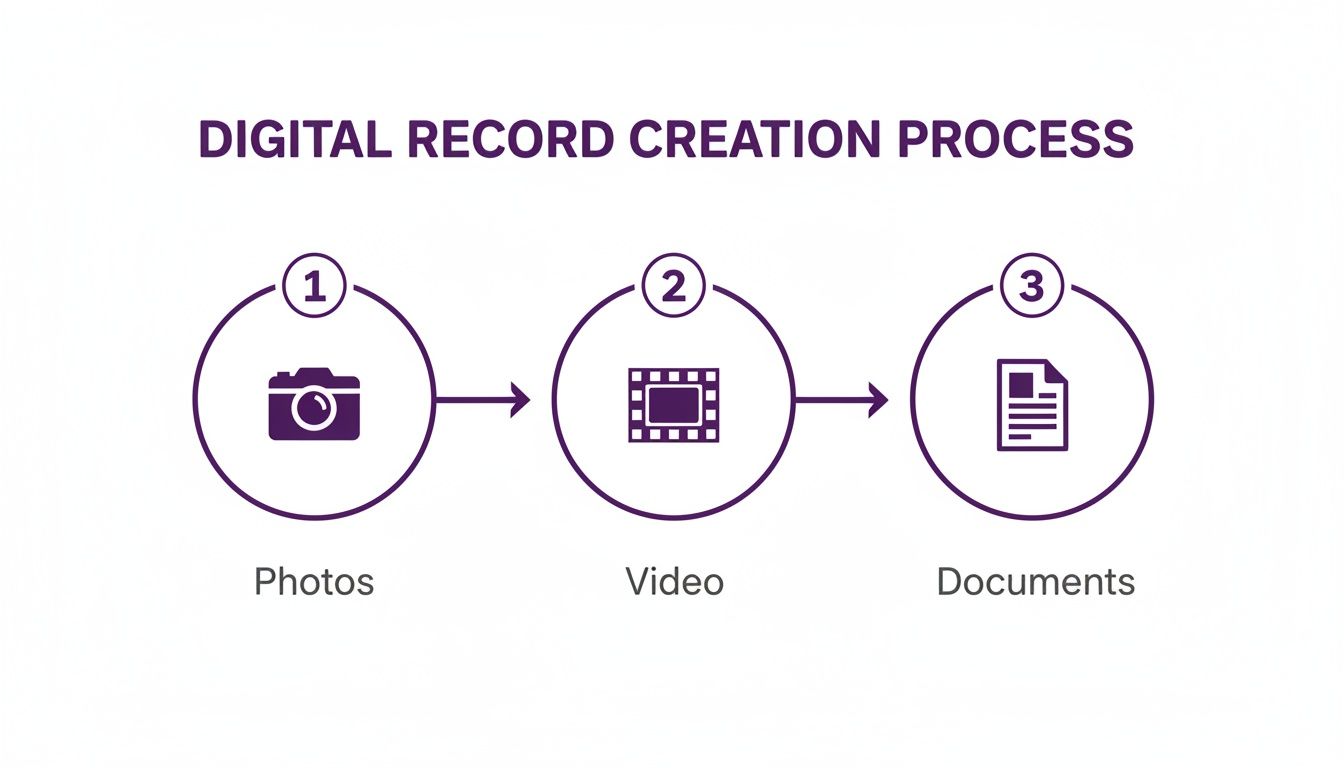 A visual process flow illustrating digital record creation from photos, video, and documents.
Each piece—the photos, the video, the documents—comes together to create a supporting record for your specific watch.
Your Step-by-Step Registration Guide
The whole process is surprisingly quick, especially if you've already built that digital vault we talked about earlier. Here’s what you’ll need to provide to a service like StolenWatch:
- Your Contact Info: Obvious but critical. They need a way to reach you if your watch surfaces.
- Watch Details: The basics—brand (Rolex), model (e.g., Datejust, Daytona), and any unique marks or features.
- The Serial Number: This is the key. Enter it with extreme care and double-check it. A typo here makes the registration useless.
- Proof of Ownership: This is where your digital vault pays off. Upload your sales receipt, a clear photo of the warranty card, or an official appraisal.
- Theft Details (If it's already stolen): You'll need to provide the date and location of the theft, along with the police report number.
I always tell people to register their watch the day they get it. Doing it before anything happens is a preemptive strike. A registry entry records submitted details; it does not establish legal ownership. Keep the supporting purchase and transfer documents separately.
You can actually see how it works by trying to search for a stolen watch yourself on one of these sites. A few minutes of prep now can be the difference between a total loss and getting your prized watch back on your wrist.
How Dealers and Buyers Can Create a Safer Market
<iframe width="100%" style="aspect-ratio: 16 / 9;" src="https://www.youtube.com/embed/yaYIOsSyRzA" frameborder="0" allow="autoplay; encrypted-media" allowfullscreen></iframe>Protecting the watch market isn't just a job for the original owner. It’s a shared responsibility that falls squarely on the shoulders of both dealers and buyers. Every time a pre-owned watch changes hands, it's a critical moment—an opportunity to either unknowingly enable the trade of stolen goods or shut that trade down completely.
For everyone involved, being proactive is the only way forward. It's how we build a safer, more trustworthy ecosystem for collectors and enthusiasts alike.
Retailers and dealers are the gatekeepers of the secondary market. Their actions directly determine which watches get to circulate and which are flagged as problematic. Because of this, performing due diligence isn't just good practice; it’s an absolute necessity for protecting their reputation and steering clear of major financial and legal headaches.
The simple, non-negotiable first step before acquiring any pre-owned piece is to check the serial number against a global stolen watch database. This one action can stop a dealer from accidentally buying a stolen watch, which could later be confiscated without any compensation. It’s a tiny investment of time that offers a powerful layer of security.
A Dealer's Due Diligence Checklist
Any reputable dealer's intake process should be systematic and rock-solid. Beyond that initial serial number search, a good protocol involves a few other key steps to make sure every watch that comes through the door is clean.
- Request Proof of Ownership: Always ask the seller for the original warranty card, sales receipt, or recent service papers. They might not always have them, but their presence adds a huge layer of legitimacy.
- Verify Seller Identity: Insist on seeing a valid, government-issued ID from the seller and keep a detailed record of the transaction. This creates a clear paper trail and is a massive deterrent to criminals.
- Document Everything: Take high-quality photos of the watch as soon as it comes in. Capture its exact condition, the serial number, and any distinguishing marks to create a clear record for your inventory.
This kind of structured approach doesn't just protect the business. It builds deep trust with customers, who know they are buying from a responsible and ethical source.
Smart Steps for Private Buyers
If you're an individual navigating the private market, the exact same principles apply. Don't ever let the excitement of a potential deal blind you to the need for careful verification. While the responsibility to register a Rolex watch with a database after you buy it is yours, the duty to check its history before you buy is just as critical.
Before any money changes hands, insist on getting the watch’s serial number from the seller. A legitimate seller will have no problem providing it. If they hesitate or refuse, consider it a major red flag and walk away from the deal immediately.
Once you have that number, run it through a database like StolenWatch yourself. This quick search is your absolute best defense against buying a watch that was stolen from another collector. By taking this small step, you not only protect your investment but also help create a market where stolen goods simply have nowhere to go. Every check helps break the chain of theft and makes the community safer for all of us.
Your Rolex Registration Questions, Answered
When you own a Rolex, you'll naturally have questions about how to best protect it. Let's clear up some of the most common ones that come across my desk, so you can feel confident you've covered all your bases.
I Bought My Rolex Pre-Owned. Can I Still Register It?
Keep the purchase invoice, transfer documents, serial number, and warranty records for your pre-owned Rolex. These support your ownership history but do not independently establish legal title.
If your watch has been stolen, follow the StolenWatchX Rolex reporting guide. Theft reporting is distinct from manufacturer warranty registration or maintaining personal ownership records.
Is There a Fee to Register on a Stolen Watch Database?
It depends on the service. Some platforms might charge a small one-time fee, which is a tiny price to pay for securing an asset worth thousands. Others might have different service tiers or subscription options.
Honestly, any small cost is a no-brainer. It's a minor investment for major peace of mind and a crucial tool if you ever need to recover your watch.
Key takeaway: Warranty records document warranty details. Theft reports record submitted information about a loss. Neither is an ownership certificate or a guarantee of recovery.
Does the Official Rolex Registration Protect Me from Theft?
This is a huge misconception, and the answer is no, not really. When an Authorized Dealer registers your new watch, it's strictly to activate the 5-year international warranty. Rolex doesn't maintain a public database that jewelers, pawn shops, or the police can use to check for stolen items.
That’s why a separate registration with a service like StolenWatch is so important. This is the step that actually alerts the secondary market—the dealers, auction houses, and collectors—that your specific watch is stolen property. It makes the watch incredibly difficult for a thief to sell and dramatically increases your odds of getting it back.
What Are the First Things I Should Do if My Rolex Is Stolen?
First, ensure you are safe. After that, time is of the essence.
- File a police report immediately. Don't wait. Get the case number and a physical copy of the report.
- Call your insurance company. Start the claims process as soon as you have the police report.
- Report the theft to a global stolen watch database. You'll need to provide the serial number and the police case number to officially flag it.
The quicker you take these steps, the faster the watch is flagged, and the harder it becomes for anyone to offload it.
Taking proactive steps is the best defense. At StolenWatch, we give owners and dealers the platform to build a more secure market for everyone. You can register your timepiece or search a serial number right now for peace of mind. Visit us at StolenWatch to get started.
Related Articles
View all
Rolex Watch Lookup: Check Serial Number and Theft
Run a Rolex watch lookup by finding the serial number, checking theft databases, and verifying authenticity before you buy, sell, or insure.
How to Find the serial number on watch
Discover where to find the serial number on watch models from Rolex, Omega, and more to verify authenticity, ownership, and insurance.

Check Titan Watch Serial Number: Verify It's Original
Learn how to check a Titan watch serial number to confirm it's original and hasn't been reported stolen. Step-by-step guide with location and verification tips.