Rolex Serial Number Check: Stolen Rolex Lookup
Run a Rolex serial number check, find where the serial is located, and verify whether a Rolex is reported stolen before buying or selling.
StolenWatch Team
Watch Authentication Specialist at StolenWatch
Run a Rolex serial number check, find where the serial is located, and verify whether a Rolex is reported stolen before buying or selling.
To run a Rolex serial number check, first locate the serial number, then search it through a trusted stolen watch database before buying, selling, or servicing the watch. You can start with the stolen watch serial number search, then use the steps below to confirm the number's location, paperwork, and red flags. For a page focused specifically on checking a stolen Rolex, see our stolen Rolex check; for the serial and reference numbers themselves, see our Rolex serial number lookup guide.
How Do You Check If a Rolex Serial Number Is Stolen?
To check if a Rolex serial number is stolen, first locate the serial on the rehaut at 6 o'clock for most post-2008 Rolex watches, or between the lugs at 6 o'clock for many older models. Enter the brand and serial number into a stolen watch database before paying the seller. Then compare the serial number on the watch with the warranty card, purchase invoice, service papers, photos, and seller ID. A clean database result does not prove the Rolex is authentic; it only means that serial number is not currently listed as stolen in the checked records. If the serial is missing, polished away, poorly engraved, mismatched with paperwork, or connected to a theft report, stop the transaction and ask a qualified watchmaker, dealer, insurer, or law-enforcement contact to review the case.
Rolex Serial Number Check: Quick Stolen-Watch Lookup
If you only need the fastest due-diligence path, use this order:
- Find the Rolex serial number on the rehaut, between the lugs, warranty card, service papers, or purchase invoice.
- Run the number through a watch serial number lookup before paying the seller.
- Compare the serial number against the watch, photos, warranty card, invoice, and any service documentation.
- If the result is unclear, pause the deal and ask for more proof of ownership before sending money.
This does not replace authentication by a qualified watchmaker, but it does answer the highest-risk question first: whether the Rolex serial number is already connected to a stolen-watch report.
Locating Your Rolex Serial Number
The first real step in checking a watch's history is getting your hands on its serial number. Think of it as the watch's fingerprint; it's essential for proving ownership and digging into its past. The location changed over the years, a conscious decision by Rolex to stay ahead of counterfeiters and make things a bit easier for owners.
Pre-2005 Models: Between the Lugs
If you're dealing with an older Rolex, one made before 2005, you'll need to look between the lugs at the 6 o'clock side of the case. The lugs are the "horns" that connect the watch case to the bracelet.
To get a look at the serial number, the bracelet has to come off. This usually requires a specific tool, and honestly, if you haven't done it before, I'd recommend taking it to a jeweler. The last thing you want is to put a deep scratch in the case while trying to find the number.
Post-2005 Models: On the Rehaut
Sometime around 2005, Rolex started engraving the serial number on a much more visible spot: the inner bezel ring, which is known as the "rehaut." By 2008, this became the standard for pretty much every model they produced.
This was a great move for a couple of reasons:
-
No Tools Needed: The number is clearly visible right through the sapphire crystal. You don't have to remove the bracelet.
-
Quick Confirmation: Just look at the inner metal ring between the dial and the crystal, down at the 6 o'clock position. The engraving is right there.
This timeline gives you a quick visual breakdown of the change.
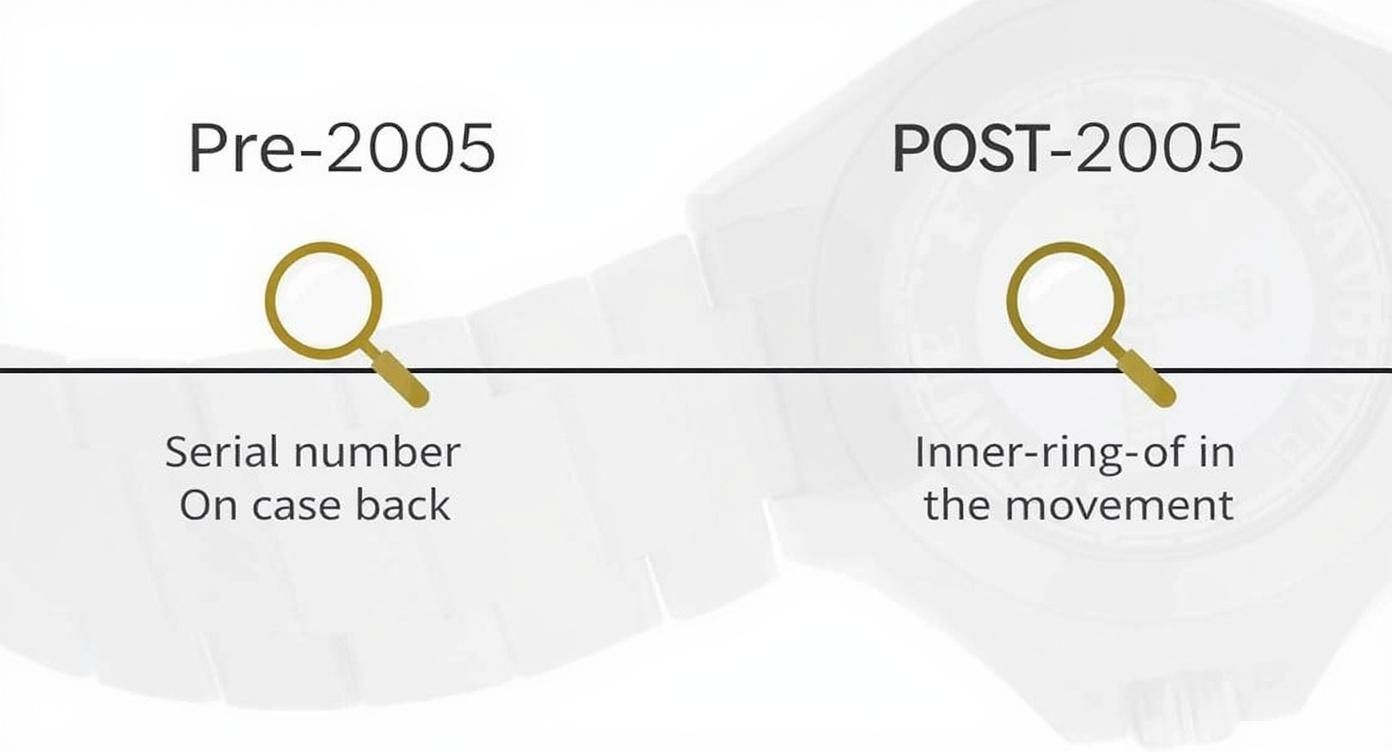 Timeline showing Rolex serial number location changes before and after 2005 with magnifying glass icons
As you can see, for vintage and older pieces, you're popping the bracelet off. For anything modern, a quick glance at the rehaut is all it takes.
To make it even easier, here’s a quick reference table to help you find the serial number based on the watch's approximate age.
Rolex Serial Number Locations by Model Era
| Model Era | Primary Serial Number Location | Secondary Location (if any) |
|---|---|---|
| Vintage & Pre-2005 | Engraved on the case between the lugs at 6 o'clock. | N/A |
| Transitional (2005-2008) | May be between the lugs OR on the rehaut. | N/A |
| Modern (Post-2008) | Engraved on the rehaut (inner bezel ring) at 6 o'clock. | N/A |
This table covers the vast majority of models you'll encounter, helping you quickly pinpoint where to look.
For a faster early check, search the serial number in the stolen watch database. Rolex-specific theft patterns are covered on the stolen Rolex watches page, and you can compare registry coverage in StolenWatch vs The Watch Register.
Why This Number Is So Important
Rolex started using serial numbers way back in 1926, engraving a unique ID on every watch. As the company grew—hitting its millionth certified chronometer by 1954—these numbers became absolutely vital for tracking inventory and, more importantly, fighting theft and fakes. If you want to dive deeper, there's a lot of great information about Rolex's brand history.
A serial number that's missing, looks like it's been polished off, or is just poorly engraved is your biggest red flag. A real Rolex engraving is sharp, deep, and perfectly clean. If what you're seeing looks sloppy, you need to be very, very careful.
Running Your Serial Number Through Stolen Watch Databases
Once you have the Rolex serial number in hand, it's time to do some digging. Checking it against global stolen watch databases is the single most critical step you can take, whether you're a buyer, seller, or an owner wanting to be thorough.
Think of it as running a background check on the watch itself. These databases are a lifeline for the watch community, compiling information from police reports, insurance claims, and individual victims. A quick search can either give you the green light or throw up a massive red flag, potentially saving you from a world of trouble and financial loss.
 Person typing Rolex serial number on laptop to check authenticity and stolen watch database
Why Professional Verification Services Are Worth It
You’ll find some free resources out there, but for a serious check, professional, paid services are in another league. The undisputed leader here is The Watch Register, which operates the world's largest and most comprehensive database of lost and stolen luxury watches. There's a reason it's the go-to for major auction houses, seasoned dealers, and serious collectors.
The power of a paid check lies in the quality and sheer volume of its data. The Watch Register isn't just a passive list; they actively partner with law enforcement and insurance agencies worldwide. Their records on stolen Rolex serial numbers are constantly being updated with verified reports, making their check the industry gold standard.
When a transaction involves thousands of dollars, spending a little on a comprehensive check is a no-brainer. It's not an expense; it's an insurance policy against a devastating financial loss, potential legal headaches, and the weight of owning stolen property.
Free vs. Paid Database Checks
So, should you go free or paid? It really boils down to how much risk you're comfortable with. Both have their uses, but they aren't created equal.
-
Free Databases: These are typically community-driven forums or lists. They can be a decent starting point and might help you catch a recently stolen watch posted by a frantic owner. The big drawback? The data is often incomplete, unverified, and can be out of date.
-
Paid Services (like The Watch Register): This is the professional-grade option. These services have deep-rooted connections with law enforcement, the global dealer network, and insurance companies. Their data is extensive, vetted, and far more reliable.
Here’s a classic scenario I’ve seen play out: A collector is about to pull the trigger on a vintage Submariner from an online seller. The price is almost too good to be true. A search on a free forum comes up clean. But, feeling cautious, they run a professional check. Bingo. The Watch Register flags the serial number from a theft reported five years ago in another country—a detail no free, community-run board would ever have.
This is exactly why a professional Rolex serial number check for stolen watches is non-negotiable for any serious transaction. As another layer of security, you can also use our own tool to search for stolen watch serial numbers. In the end, investing in a proper check is about protecting your wallet and upholding the integrity of the entire pre-owned watch market.
Spotting Red Flags in Serial Numbers
A successful Rolex serial number check for stolen watches goes way beyond just plugging a code into a database. The serial number itself tells a story, and from my experience, learning to spot the subtle inconsistencies is the most critical skill you can develop. Counterfeiters have gotten scarily good, but they almost always stumble on the tiny, precise details that make a Rolex a Rolex.
Take a close look at the engravings. On a genuine Rolex, they're a thing of beauty—typically diamond-dragged, creating deep, clean lines that catch the light perfectly. Tilt the watch and you should see the numbers almost shimmer. Fakes, on the other hand, often have engravings that look dull, shallow, or almost sandy. This is usually the result of acid-etching or a cheap stamping process. If the engraving looks sloppy or just lacks that crisp, definitive edge, that’s a massive red flag.
 Close-up of watchmaker hands using precision tool to service luxury watch movement and dial
The Shift to Randomized Serial Numbers
For years, Rolex used a predictable, sequential numbering system. This was great for dating watches, but it handed counterfeiters a roadmap. They could easily produce a fake and slap a serial number on it that fit logically within a specific production year, making their fakes much harder to detect. Rolex knew they had to close this loophole.
Around 2010, they made a game-changing move by switching to randomized serial numbers. This was a direct shot at counterfeiters, making it exponentially harder to guess or create a convincing fake serial number. The old patterns were gone. These new mixed serials typically have 8 digits with a random mix of letters and numbers—think codes like 'OT23Q257', '52335J78', and '345X29VN'. You can find more details about these modern Rolex serial numbers and their impact.
What does this mean for you? While you can't easily date a modern Rolex by its serial number alone anymore, it gives you a powerful new way to spot a fake. If you're looking at a newer model but it has an old-style sequential number, something is seriously wrong.
Mismatched Numbers and Paperwork
One of the most common giveaways of a stolen or fraudulent watch is a mismatch between the number etched on the watch and the number on its paperwork. A legitimate, complete Rolex set will always include a warranty card or certificate with the watch’s unique serial number printed on it. These two numbers absolutely must match. No exceptions.
Keep an eye out for these common trouble spots:
-
Watch and Papers Don't Match: This is the most obvious one. The serial number on the rehaut (or between the lugs on older models) is different from what's on the warranty card.
-
Altered Paperwork: Look closely at the card itself. Do you see any signs of tampering? Mismatched fonts, blurry printing, or even sticker residue can be signs that someone has tried to alter the original number.
-
The "Frankenwatch" Alert: This is where things get tricky. Sometimes thieves will piece together a watch from different parts. For instance, you might see a case with a serial number that dates it to 1995, but the dial and hands are clearly from a 2015 model. This is a classic "Frankenwatch" and a definite warning.
The ultimate red flag is a serial number that simply doesn’t exist. If the number on the watch doesn't align with any known Rolex production format or series, you are almost certainly looking at a counterfeit. Always double-check the number against the watch's physical characteristics.
What To Do If a Watch Is Flagged Stolen
https://www.youtube.com/embed/qFQ_s3dIAz4
That sinking feeling you get when a serial number search flags a watch as stolen is unmistakable. Whether you're a buyer, a dealer, or the original owner who just got a lead, it can be a jarring moment.
The most important thing is to stay calm and follow a clear-headed process. How you handle the next few minutes will look very different depending on who you are in this situation. Rushing in or trying to resolve things on your own can quickly turn a bad situation into a much worse one.
For Potential Buyers
You're about to pull the trigger on a new piece, you run a quick Rolex serial number check stolen watch database, and—bam—you get a hit. The path forward here is refreshingly simple: stop.
Do not buy the watch.
Politely thank the seller for their time and walk away from the deal. There's no need for a confrontation or a lengthy explanation. Trying to negotiate a "deal" or otherwise continuing the conversation can land you in some very murky legal water.
After you've walked away, consider reporting the finding. You can confidentially let the database know where you found the match. It's also a good idea to file a report with local law enforcement, giving them the serial number and any details you have about the seller.
For Dealers and Jewelers
When a customer brings in a watch for sale, trade, or even just a service, and it gets flagged in your system, you're on the front lines. You have both a legal and an ethical obligation to act responsibly.
The first step is to stall the transaction without raising suspicion. You could explain that your authentication process is detailed and requires a bit more time or that you need to run some additional checks in the back. The goal is to keep the situation calm and professional. Never confront the person directly—your safety and that of your staff is the top priority.
Here's a practical game plan:
-
Secure the Watch: If you can, hold onto the timepiece. Tell the client you need to pass it to your watchmaker for a full assessment and you'll call them back.
-
Contact Authorities: As soon as it's safe, contact your local police department and the database service that flagged the watch. Give them the serial number and a clear description of the person who brought it in.
-
Document Everything: Make detailed notes of the entire interaction. Jot down the time, date, what the person said, and any contact information they provided.
This professional approach not only protects your business from legal trouble but also strengthens your reputation as a trusted partner in the industry.
Remember, knowingly buying or selling stolen property isn't just unethical—it's a serious crime. The professional standard is to cooperate fully with law enforcement to help get the watch back where it belongs.
For Owners Who Have Located Their Watch
Seeing your stolen watch pop up on an online marketplace or in a dealer's window is a rush of emotion. It's a huge moment, but the recovery process has to be handled by the book.
Your very first call should be to the police department where you originally filed the theft report. Have your case number ready and give them all the new information you’ve found—screenshots, links, the shop's address, everything.
Do not, under any circumstances, try to contact the seller or recover the watch yourself. It's a dangerous move that could compromise your safety and the official police investigation. Let the professionals do their job. If for some reason you never registered the theft online, now is the time to formally report your stolen watch. This creates a permanent digital record that gives authorities and dealers the proof they need to act on your behalf.
Verifying Authenticity Beyond the Serial Number
Running a Rolex serial number check for stolen watches is a critical first step, but don't stop there. True peace of mind when buying a pre-owned Rolex comes from looking at the complete picture: its history, its documents, and the physical timepiece itself.
A clean serial number confirms a watch hasn’t been reported stolen, but it doesn't prove it's the real deal. This is where provenance—the watch's life story—comes into play.
Think of provenance as the watch's verifiable history, from the original sales receipt to service records. A watch that comes with its full documentation, often called a "full set" or "box and papers," is always a safer bet and holds its value far better.
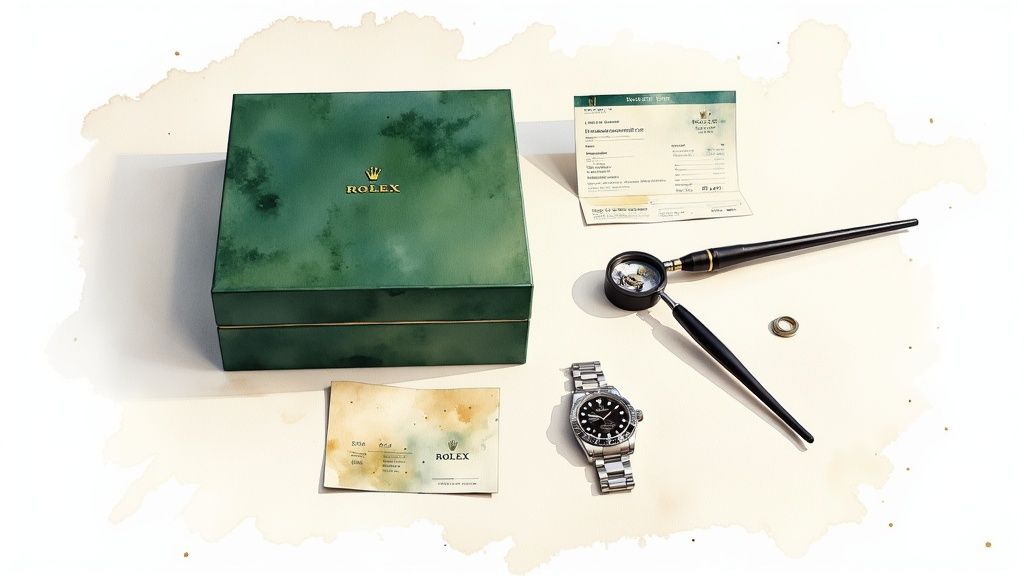 Rolex watch with authentication papers, loupe, and green presentation box for verification
Scrutinizing the Paperwork
When a seller hands you the documents, it's time to put on your detective hat. The original warranty card is the star of the show. It should clearly list the watch's model and, most importantly, the serial number. That number must be an exact match to the one engraved on the watch.
Keep an eye out for common signs of forgery:
-
Mismatched Fonts: Does the printing on the warranty card look a little off? Rolex uses specific, crisp, high-quality printing. Anything blurry or inconsistent is a major red flag.
-
Fishy Handwriting: On older papers, look for signs of alteration in the handwritten details. The ink and style should be consistent.
-
Service Records: Legitimate service records from Rolex or an authorized dealer are always professional and detailed, adding another layer of trust.
Imagine this scenario: a seller offers a beautiful vintage GMT-Master with its warranty card. Everything looks good until you notice the ink used for the serial number is a slightly different shade than the rest of the text. This tiny detail could mean a blank card was filled out fraudulently to match the watch. You can learn more about how documents are authenticated through services offering certificate verification to ensure all the paperwork is legitimate.
Remember, a complete and authentic set of papers makes it much harder for a stolen watch to be sold. Thieves rarely manage to get away with the box and documentation, making their absence a potential red flag.
When you're dealing with a significant purchase, going beyond the serial number and paperwork is just common sense. The following checklist covers the essential items you should be looking for to ensure you're getting an authentic, well-documented timepiece.
Verification Checklist Beyond the Serial Number
| Verification Step | What to Look For | Importance Level (High/Medium) |
|---|---|---|
| Warranty Card/Papers | The serial number must match the watch exactly. Check for consistent, high-quality printing. | High |
| Original Box | Is it the correct style and period for the watch model? Check for signs of excessive wear or damage. | Medium |
| Service History | Look for receipts from Rolex Service Centers or certified watchmakers. Verifies maintenance and ownership. | High |
| Original Purchase Receipt | This is the ultimate proof of origin, linking the watch to its first owner and authorized dealer. | High |
| Hang Tags | The green chronometer tag and model-specific tag should be present, matching the watch details. | Medium |
| Instruction Manual | Should be the correct manual for the specific model and year. | Medium |
This checklist isn't just about ticking boxes; it's about building a complete and credible history for the watch. The more of these items that are present and correct, the more confident you can be in your purchase.
When to Call in a Professional
There's a point where you need to hand it over to an expert. If you have even the slightest doubt about a watch’s authenticity or provenance—or if you’re about to make a major investment—consulting a certified watchmaker is non-negotiable.
A professional can do what you can't: open the case back and inspect the movement. Counterfeiters have gotten scarily good at replicating a Rolex exterior, but faking the complex, in-house movement is another story. An expert will spot a fake movement, mismatched parts, or shoddy repair work in seconds.
They can also confirm that the dial, hands, bezel, and bracelet are all correct for that specific model and production era. This final appraisal is your definitive confirmation that the watch is not only not stolen but is 100% genuine.
Got Questions About Stolen Rolex Checks?
Even with a step-by-step guide, you're bound to run into some tricky real-world situations when checking a Rolex serial number. A few questions pop up time and time again, so let's get you some straight answers to help you avoid a costly mistake.
What If the Serial Number Is Hard to Read?
This is a classic issue, especially with older, well-loved Rolexes. Decades of a metal bracelet rubbing against the case can polish the engraved serial number until it's barely a whisper.
First, don't guess. A wrong digit is as bad as no digit at all. Grab a good quality jeweler's loupe and find some bright, direct light. I've found that tilting the watch case back and forth can help the light catch the faint edges of the numbers.
If it’s still a no-go, your best and only real option is to take it to a trusted professional watchmaker. They have the experience—and often specialized tools—to decipher numbers that look like a complete blur to the rest of us.
Can I Just Ask Rolex to Verify a Watch for Me?
It’s a logical question—why not go straight to the source? Unfortunately, the short answer is no. Rolex doesn't offer a public service where you can call or email a serial number to check its history or status.
What they do have is a massive internal database of stolen timepieces. If a watch reported as stolen ever makes its way to an official Rolex Service Center or an authorized dealer for a service, it gets flagged immediately. The watch is then confiscated, and both the authorities and the original owner are contacted. While this is a powerful recovery tool, it’s not a verification hotline for buyers.
A common myth is that you can just email Rolex with a serial number and get a full history report. In reality, their policy is to work through official channels like law enforcement and their own authorized network, and only when the watch is physically in their hands.
What Are the Legal Risks of Buying a Stolen Watch by Accident?
Buying a stolen Rolex, even if you had no idea, can land you in serious trouble. In most places, possessing stolen property is a crime, period. Your knowledge of its history doesn't always matter.
If the watch is ever identified, law enforcement will confiscate it and return it to its rightful owner. You lose the watch and the money you spent. Imagine buying a watch from a private seller online, only to find out it's stolen when you take it for a service. Your only option is to try and sue the seller, which is a long, expensive, and often fruitless battle.
This is exactly why running a thorough check before any money changes hands isn't just a good idea—it's critical self-defense. It protects your investment and ensures you aren't accidentally fueling the market for stolen luxury goods, a problem that hurts the entire watch community.
Protect your collection and ensure every transaction is transparent with StolenWatch. Use our dedicated database to check serial numbers, report thefts, and buy with confidence. Verify your watch today at https://stolenwatchx.com.
Related Articles
View all
Check Citizen Watch Serial Number: Location & Record Search
Find your Citizen watch serial number, compare matching records, and understand why a lookup does not prove authenticity, ownership, or complete history.
Check Titan Watch Serial Number: Verify It's Original
Learn how to check a Titan watch serial number to confirm it's original and hasn't been reported stolen. Step-by-step guide with location and verification tips.

How to Obtain a Certificate of Authenticity for a Watch
Learn how to obtain a certificate of authenticity for a watch, what documents matter, and why a stolen-watch check should come before any certificate request.