Value of Watches by Serial Number: What to Check
Learn what a watch serial number can reveal about age, authenticity, theft history, provenance, and market value before you buy or sell.
StolenWatch Team
Watch Authentication Specialist at StolenWatch
Learn what a watch serial number can reveal about age, authenticity, theft history, provenance, and market value before you buy or sell.
A watch serial number does not give you an exact price, but it is the starting point for valuing a watch because it helps verify age, authenticity, provenance, and theft history. Before relying on condition or market comps, search the serial number for stolen watch reports so a flagged watch does not distort the valuation.
Watch Serial Number Checker: Value, Age, and Theft History
If you are using a watch serial number checker to estimate value, use this order:
- Confirm the serial number is legible and matches the papers.
- Search the serial number for theft history.
- Use the serial to narrow the production year and reference.
- Compare condition, originality, service history, and market comps.
That is the fastest way to turn a number into a defensible valuation instead of a guess.
What a Watch Serial number Actually Reveals
On its own, a serial number can often give you a surprisingly good idea of when a watch was made. For brands like Rolex, that number can narrow down the production year to a specific range, immediately placing the watch in its historical context. An older watch isn't always more valuable, but knowing its age is a critical piece of the puzzle.
But the number itself doesn't shout, "I'm worth $10,000!" Its real power is what it lets you find out elsewhere. This single string of digits is the foundation for all your research, turning a simple marking on the case into an essential tool for protecting your investment.
From Identification to Verification
Getting from a serial number to a solid valuation is a multi-step process. First, the number helps confirm that the watch matches a known model from a certain period. But its most important job is to serve as a lookup code for the details that really matter.
This is where the detective work begins. By running that serial number through the right channels, you can uncover a watch's hidden history, including:
- Authenticity Confirmation: Does the serial number align with the known features and styles for that model and production year? Mismatches are a huge red flag.
- Provenance and History: Can you link the watch to previous owners, auction results, or service papers? A rich, documented history can dramatically increase a watch's value.
- Theft Status: Is the watch listed on a global stolen watch registry? This is a non-negotiable check for any buyer, seller, or insurer.
A clean check against a stolen watch database like StolenWatch is paramount. A flagged serial number can render an otherwise perfect watch virtually worthless on the legitimate market.
Understanding this distinction is everything. The serial number is just your starting point; the story it unlocks through careful research is what ultimately determines its fair market price. Without that verification, you’re flying blind.
What Your Serial Number Tells You at a Glance
So, what does that string of digits really tell you? Here’s a quick breakdown of what you can learn from the number itself versus what you discover by checking it against external records.
| Attribute | Directly from the Number | Revealed by Database Checks |
|---|---|---|
| Production Date | Often (Varies by brand) | Confirms date ranges and model specifications. |
| Model Authenticity | Partially (Confirms a valid number exists) | Verifies against known authentic models. |
| Provenance & History | No | Yes (Links to past sales, service, or owners). |
| Theft Status | No | Yes (The most critical check for any transaction). |
As you can see, the number on the watch is just the beginning. The real value is found when you use that number to dig deeper and verify its history and legitimacy.
Start with a quick stolen watch serial number search, then compare brand-specific risk using the stolen Rolex database, stolen Omega database, or stolen Patek Philippe database when the watch brand is known.
How to Properly Check a Watch Serial Number
Think of a watch's serial number not as a price tag, but as the starting point for a proper background check. It's a methodical process, and it’s what separates a sound investment from a major headache. The first step, naturally, is to find the number itself.
Where it's located really depends on the brand and its age. On a lot of vintage Rolex models, for instance, you have to carefully pop the bracelet off to find the serial number engraved between the lugs. With newer Rolexes, you can often spot it on the inner bezel, what collectors call the rehaut. Other brands might stamp it on the case back or, in some cases, right on the movement itself, which means a watchmaker will have to open it up for you.
Once you have that number in hand, the real detective work begins.
Your Initial Verification Checklist
Before you get into the heavy-duty database checks, you need to cover the basics. This first pass helps you confirm the watch’s identity and get a ballpark idea of its age, which sets the foundation for the more critical steps to come.
-
Locate and Document the Number: First things first, write down the full serial number without any mistakes. It's also a great idea to take a few clear, magnified photos of the engraving. The quality of the engraving—its sharpness, depth, and consistency—is your first big clue. Fakes often betray themselves with sloppy, shallow, or acid-etched numbers that just don't look right.
-
Estimate the Production Date: Now, use that serial number to figure out when the watch was made. For many of the big brands, you can find charts or online decoders that will help you out. For example, a Rolex with a "U" at the start of its serial number was most likely made around 1997. This date becomes your anchor for everything else.
-
Cross-Reference with Model Features: Does the watch actually look like it was made in its supposed production year? A 1997 watch shouldn't have features or parts that were only introduced in 2010. If the date from the serial number doesn't line up with the physical watch, you're looking at a huge red flag. It could be a "Frankenwatch"—a timepiece cobbled together from different watches.
This whole process shows how one little number kicks off a journey of verification that ultimately leads to a watch's true, defensible value.
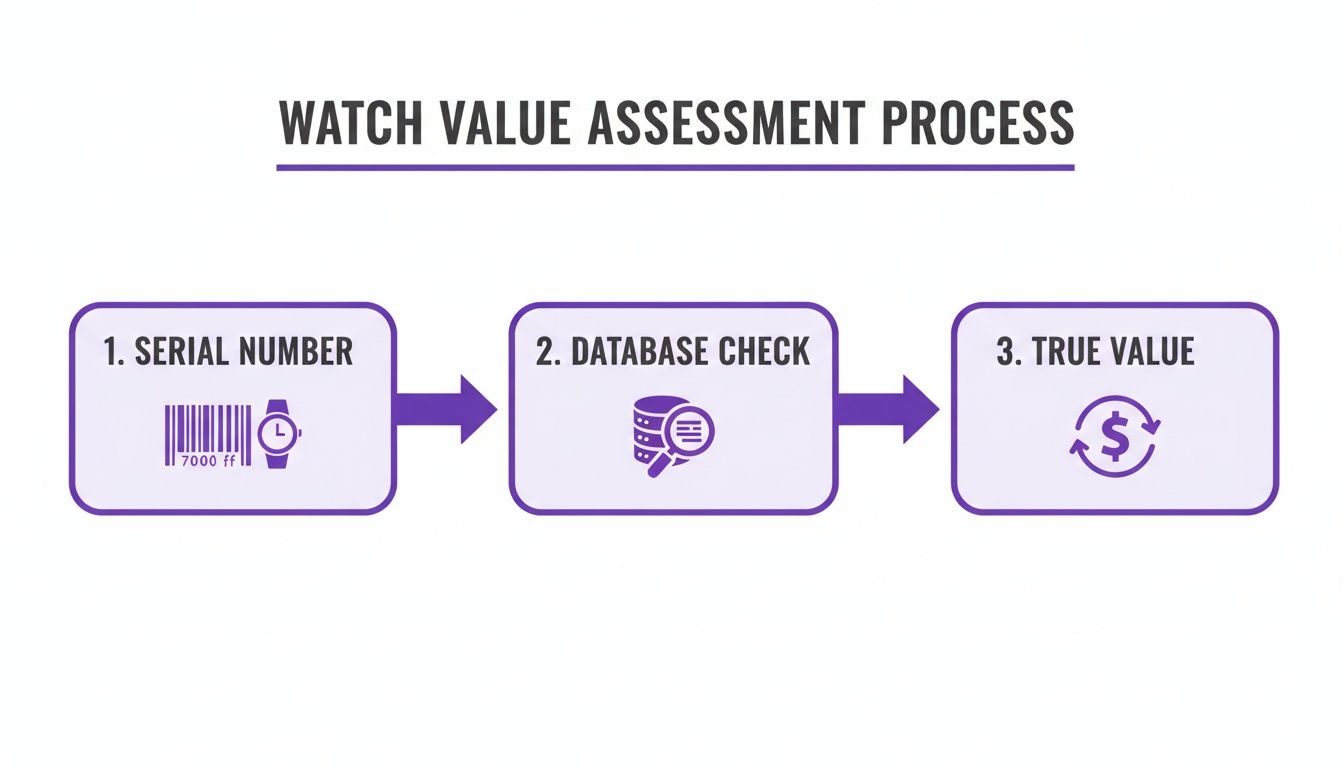 Flowchart showing the watch value assessment process using serial number, database check, and true value.
The serial number is just the key that starts the engine; it's not the final destination.
The Most Important Step: Database Verification
After you’ve done your initial homework, it’s time for the single most important action you can take: running the serial number through a global stolen watch database. If you’re serious about figuring out the value of watches by serial number, this step is absolutely non-negotiable.
This is your only real shield against buying, selling, or insuring a stolen watch. A database check turns a simple string of digits into a powerful security tool, giving you a layer of protection that a visual inspection alone could never provide.
A serial number that looks perfect but is flagged in a global registry instantly turns a beautiful watch into a toxic asset. No amount of pristine condition or original paperwork can change the fact that it's stolen property.
Here's why this is so critical: a watch on a stolen list is effectively worthless on the legitimate market. You can't sell it through any reputable dealer, you can't get it serviced by the manufacturer, and you can't insure it. Trying to transact a stolen watch, even if you had no idea, can land you in a world of legal and financial trouble.
Databases like StolenWatch bring together reports from owners, law enforcement, and insurance companies, creating a powerful safety net. You can easily search for a stolen watch by its serial number and see if the timepiece has a clean record. This simple search is the final, crucial piece of the valuation puzzle. Skipping it is a gamble that no collector, dealer, or buyer should ever take.
Uncovering a Watch's Story and Rarity
A serial number is far more than just a random string of digits stamped on a watch; it's the thread you can pull to unravel its entire history. This unique identifier is the starting point for piecing together the narrative that builds a timepiece's true collectible value, turning what looks like a simple watch into a tangible piece of the past.
Think of it like a car's VIN. Sure, the VIN tells you the make and model, but its real power is in letting you pull a detailed history report. In the same way, a watch's serial number is your primary tool for investigating its background, and that's often where the most significant value lies hidden.
Decoding Provenance and Ownership History
One of the most powerful drivers of a watch's value is its provenance—the documented, unbroken chain of ownership. A serial number is the anchor that moors a watch to its history, allowing you to connect a specific timepiece to auction records, old service papers, and, in some incredible cases, its original owner.
Let's take two identical vintage Speedmasters. One is just a watch, plain and simple. The other, however, can be verified by its serial number as having been worn by an astronaut. Suddenly, that second watch is no longer just a timepiece; it's a historical artifact. Its value could easily be ten, or even a hundred times greater, all because that serial number links it to an extraordinary story.
Provenance is what elevates a luxury item into a historical object. A serial number that can be tied to a famous person, a specific military unit, or a landmark event adds a layer of value that condition and rarity alone could never achieve.
This is where determining the value of watches by serial number becomes more of an art than a science. You're not just checking a box on a list; you're tracing a timeline. A clean, well-documented history, all confirmed by that crucial serial number, builds incredible trust and desire in the collector market.
Identifying Rare and Transitional Models
Beyond a watch's individual journey, serial numbers are essential for identifying pieces from special, limited, or "transitional" production runs. Brands don't always advertise these variations, making them hidden gems for collectors who know what to look for.
For instance, a particular range of serial numbers might point to a "transitional" model—a watch made for a very short time as a manufacturer shifted from an old design to a new one. These pieces often feature unique combinations, like an old-style dial inside a newer case, making them exceptionally rare and sought-after.
Here’s how a serial number can flag a rare find:
- Limited Editions: The number can confirm if a watch is one of a small, exclusive batch.
- "First Batch" Models: Collectors often prize the earliest serial numbers of a new reference.
- Military-Issued Watches: Specific serial number blocks were frequently assigned to military contracts, giving those watches a distinct and valuable history.
A quick serial number check could reveal that a watch you assumed was standard is actually a rare variant, completely changing its market value.
A Powerful Weapon Against Fakes
Finally, and perhaps most importantly, the serial number is one of your strongest defenses against the increasingly sophisticated fakes flooding the market. Counterfeiters have gotten scarily good at mimicking cases and dials, but they often trip up on the details of serial numbers.
They might lazily use the same serial number on hundreds of fakes, which a quick search will immediately expose. Other times, they’ll use a number that doesn't match the watch's supposed production era. A database check can flag these inconsistencies in seconds, protecting you from a very expensive mistake. For a deeper dive, you can learn more about how certificate verification strengthens authenticity checks in our detailed guide.
Why Global Databases Are Your Best Defense
In a world where a watch can be stolen in one country and reappear for sale in another within days, just giving it a quick once-over isn't enough. Relying on a simple visual inspection is like trying to navigate a new city without a map—you're bound to get lost, and in this case, it could cost you dearly. The sophisticated networks that move these stolen timepieces operate on a global scale, making a local check almost completely useless.
This is exactly where a global stolen watch database becomes an essential tool, not just a nice-to-have. Think of these platforms as the central nervous system for the entire watch industry. They connect everyone from individual owners and insurers to dealers and law enforcement, creating a powerful, real-time safety net that no single person or business could manage alone.
 A conceptual image with a globe connecting two distinct watches and a security shield with a magnifying glass, all enhanced with watercolor splashes.
The Power of a Collective Shield
Imagine a neighborhood watch program that spans the entire globe. That’s essentially what a global database does. When a watch is reported stolen in London, a dealer in Hong Kong gets an instant alert if that same serial number pops up. This web of interconnectedness is the only real defense we have against stolen watches being laundered back into the legitimate market.
The process is surprisingly straightforward but incredibly effective. An owner registers their stolen watch's serial number, and that number is immediately flagged. Later, when someone is about to buy a pre-owned watch, they can run a quick check. If the number is on the list, the deal is stopped, authorities can be notified, and a huge financial headache is avoided.
A comprehensive database check isn’t just another step in the process—it is the most critical one. It turns the value of watches by serial number from a hopeful guess into a verified fact, protecting your investment and the integrity of the market.
This system makes life very difficult for thieves. When they realize that a stolen watch is easily traceable and almost impossible to sell through any reputable dealer, the entire incentive to steal it in the first place starts to crumble. It’s a proactive defense that protects us all.
A Look at the Numbers
The scale of watch theft is genuinely staggering, but the effectiveness of these registries is just as impressive. The global stolen watch market is huge, with the leading databases now tracking over 110,000 registered lost and stolen timepieces.
Leading stolen watch databases report recovering about five lost or stolen watches every single day. That number alone shows just how vital serial number verification is. Industry data reveals that 50% of recovered watches are found within a year of being stolen, and an impressive 35% are found in just six months.
This isn't just about getting stolen property back. It's about building the trust and confidence that the pre-owned market needs to function. Without this layer of security, every transaction would be a gamble. It's also worth looking at the different services out there; for instance, our guide comparing https://stolenwatchx.com/stolenwatch-vs-the-watch-register can help you understand the options. Every single successful check makes the market safer and stronger for everyone involved.
Common Mistakes and Red Flags to Avoid
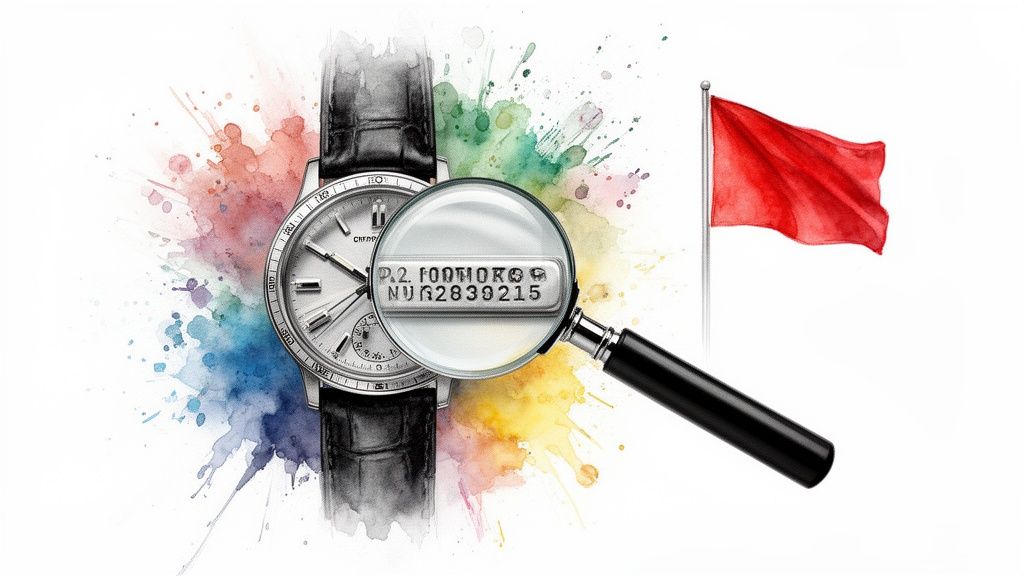 A watch with a magnifying glass highlighting its serial number, alongside a red flag, symbolizing verification.
The pre-owned watch market is a thrilling place, but it's not without its pitfalls. Knowing how to spot the warning signs is just as crucial as knowing what makes a watch valuable. Think of this as your guide to navigating the market safely, helping you sidestep those costly mistakes that can sour a great find.
One of the biggest blunders is taking a serial number at face value without digging deeper. A seller might confidently hand you a number, but that string of digits could belong to a completely different watch, a known counterfeit, or worse, a stolen piece. A serial number is just data; its real power comes from proper verification.
Another huge error is ignoring the details. Let's say the serial number points to a production date of 1997, but the watch has a dial style or bracelet that wasn't released until 2008. That's a massive red flag. You're likely looking at a "Frankenwatch"—a timepiece cobbled together from mismatched parts, which absolutely tanks its value and authenticity.
Recognizing Seller Red Flags
Often, your gut feeling about a seller is your best first line of defense. A reputable seller will be open, transparent, and happy to give you everything you need to feel confident. Anyone who dodges questions or puts up roadblocks is usually hiding something.
Keep your eyes peeled for these warning signs:
- Reluctance to Provide Photos: If a seller hesitates to send clear, high-resolution pictures of the serial number, case back, and movement, just walk away. There's no good reason to hide these essential details.
- A Price That's Too Good to Be True: In the world of watches, true bargains are few and far between. A price that's way below market value is usually bait for a fake, a Frankenwatch, or stolen goods.
- Vague or Unverifiable Stories: A seller with a great story but no paperwork is selling you fiction. Real provenance comes with proof, not just a good yarn.
Never accept a seller’s story at face value. A legitimate history will have a paper trail—service records, original receipts, or auction listings. Without that evidence, a story is just a story.
These simple checks can save you a world of hurt. Remember, you're the one in control. If something feels off, it probably is.
Inspecting the Watch for Physical Tampering
Beyond the seller's behavior, the watch itself holds clues to its past—if you know what you're looking for. Physical tampering with a serial number is one of the most serious red flags you can find, as it almost always points to an attempt to conceal a stolen watch.
When you inspect the watch, scrutinize the engravings. Authentic serial numbers are typically sharp, clean, and precisely machine-etched, often with crisp, diamond-cut edges. Be suspicious of numbers that look shallow, blurry, or have a "dotted" appearance, as these are common signs of cheap acid etching used by counterfeiters.
Also, check the area around the engravings. Do you see excessive polishing, scratches, or tool marks concentrated near the serial number? That's a strong sign someone has tried to buff out or alter the original digits. A watch with a tampered-with or completely removed serial number is essentially worthless on the legitimate market and should be avoided at all costs. It's a dead giveaway of illicit activity.
Protecting Your Investment with Serial Number Checks
Think of a serial number check not as a chore, but as one of the smartest investments you can make when dealing with pre-owned luxury watches. It’s a simple step that directly protects the value of watches by serial number and safeguards your hard-earned money.
For a buyer, this is your peace of mind. A clean serial number check turns a hopeful purchase into a secure investment. It's the only way to be sure you're buying a legitimate timepiece, not a stolen one that could be confiscated tomorrow, leaving you with nothing.
For a seller, this is your reputation. A verified, clean history is the foundation of trust, allowing you to ask for a fair market price. Without it, you’re planting a seed of doubt that can kill a deal or cause major headaches down the road.
The Economic Case for Verification
This simple act of due diligence sends positive ripples throughout the entire industry. Insurance companies depend on serial number checks to validate claims and avoid paying out on fraudulent ones. Police departments use this data to hunt down and recover stolen watches, making the market safer for everyone.
The financial logic is crystal clear. Spending a small amount on a comprehensive database search is nothing compared to the catastrophic loss of a five or even six-figure watch.
In the luxury watch market, what you don't know can absolutely hurt you. Proper verification isn't an optional add-on; it's a core component of a sound financial decision, protecting capital and preserving value.
Seeing verification as an investment—not a cost—is a crucial shift in mindset. It empowers everyone, from individual buyers to established dealers, to act with confidence, secure their assets, and uphold the integrity of the market.
Certification as a Value Multiplier
The financial importance of checking serial numbers has grown so much that major databases now offer tools specifically designed to prevent these kinds of losses. StolenWatchX, for example, provides checks for Rolex and every other major brand, even issuing certificates for watches that clear the system. This gives you tangible proof of a clean history.
This certificate adds real, measurable value to any watch. It gives a buyer the confidence to pull the trigger and protects a seller's reputation—two of the most valuable assets in a market where watches can be worth hundreds of thousands of dollars. It’s a powerful tool for closing deals and building a trustworthy brand.
Frequently Asked Questions
It's natural to have questions when you're trying to make sense of watch serial numbers. I get them all the time. Whether you've been collecting for decades or you're just looking at your first serious purchase, getting clear answers is what separates a smart decision from a costly mistake.
Let's walk through some of the most common questions I hear about using a serial number to figure out a watch's value. My goal here is to help you use this information correctly and sidestep the usual traps.
Can a Watch Serial Number Tell Me the Exact Market Value?
No, not directly. Think of a serial number less like a price tag and more like a key. It unlocks crucial information—like the production date and model authenticity—that you absolutely need for a proper valuation. But its most powerful function is verifying that the watch has a clean history on a stolen watch registry.
A watch can only realize its true market value if its serial number comes back clean. The final price tag will always come down to a combination of its physical condition, whether it includes the original box and papers, and what collectors are willing to pay for it at that moment.
What Should I Do If a Serial Number Is Flagged as Stolen?
If a database check flags a watch as stolen, stop everything. Do not, under any circumstances, move forward with the purchase. This is the biggest red flag you can get. If you're a professional dealer, you need to politely and immediately end the negotiation.
Depending on where you are, you may be legally required to report the encounter to local police, sharing whatever details you have about the seller. Never try to be a hero and confiscate the watch yourself. Your only job is to protect yourself and avoid getting involved in the trade of stolen goods.
An encounter with a stolen watch is a serious matter. Your immediate priority is to disengage safely and cleanly from the transaction to avoid any legal or personal risk.
Are Online Serial Number Dating Tools Reliable?
Those online decoders can be handy for a quick guess at a watch's production year, but you should never rely on them as your only source. Many of these sites are built on unofficial data that can be patchy or just plain wrong. A real valuation goes much deeper.
The best use of a serial number is for what it was designed for: running a thorough check against a global stolen watch database. After that, you need an expert to confirm that the watch's other parts—the dial, hands, bezel, and so on—are all correct for the production period the serial number suggests.
What If a Watch's Serial Number Is Missing or Unreadable?
A missing or illegible serial number is a huge problem. It crushes the watch's value and makes it incredibly difficult to sell. If the number has simply worn down from decades of use, an expert can sometimes restore it enough to be read.
But if it looks like the number was intentionally ground off or polished away, you should assume the worst—it's likely stolen. A watch with a tampered serial number is a pariah in the legitimate market and is often only worth the scrap value of its parts. Be extremely careful if you ever come across one.
Make sure every watch that passes through your hands has a clean history. With StolenWatch, you can run fast, dependable serial number checks to protect your investments and your reputation. Join a community building a safer, more transparent watch market. Visit StolenWatch to run your first search today.
Related Articles
View all
How to Authenticate a Rolex Watch An Expert Guide
Learn how to authenticate a Rolex watch with our expert guide. Discover how to check serial numbers, spot fakes, and verify a genuine Rolex with confidence.

Check Citizen Watch Serial Number: Location & Record Search
Find your Citizen watch serial number, compare matching records, and understand why a lookup does not prove authenticity, ownership, or complete history.
A Practical Guide to Your Watch Serial Number Check
Use this comprehensive guide to perform a watch serial number check. Learn to verify authenticity, identify fakes, and protect your luxury watch investment.