Your Guide to Watch Serial Number Lookup
Use our guide for a watch serial number lookup to verify authenticity, check its history, and determine its age. Learn how to protect your investment.
StolenWatch Team
Watch Authentication Specialist at StolenWatch
Use our guide for a watch serial number lookup to verify authenticity, check its history, and determine its age. Learn how to protect your investment.
Before you even think about buying, selling, or insuring a high-end timepiece, there’s one piece of information that trumps all others: its serial number. A watch serial number lookup is the single most important step you can take. It turns a simple string of digits into a story of authenticity, age, and ownership, giving you the solid proof you need to move forward with confidence.
Ready to run one yourself? Our Watch Serial Number Lookup hub walks through where to find the number on your specific brand and lets you check it against stolen-watch records.
What Does a Watch Serial Number Lookup Tell You?
A watch serial number lookup helps verify whether a luxury watch has been reported stolen, whether the serial format matches the brand and production era, and whether the number agrees with the watch's paperwork. It is similar to checking a vehicle identification number before buying a car: it can reveal theft risk, ownership inconsistencies, and obvious counterfeit warning signs. A lookup cannot prove authenticity by itself because counterfeiters can copy real serial numbers onto fake watches. Buyers should use the lookup as the first step, then inspect the engraving quality, compare the serial with warranty cards and service records, confirm the model and reference details, and ask a qualified watchmaker or authorized dealer to inspect expensive purchases. If a database flags the watch as stolen, do not complete the transaction.
Why a Serial Number Is Your First Check
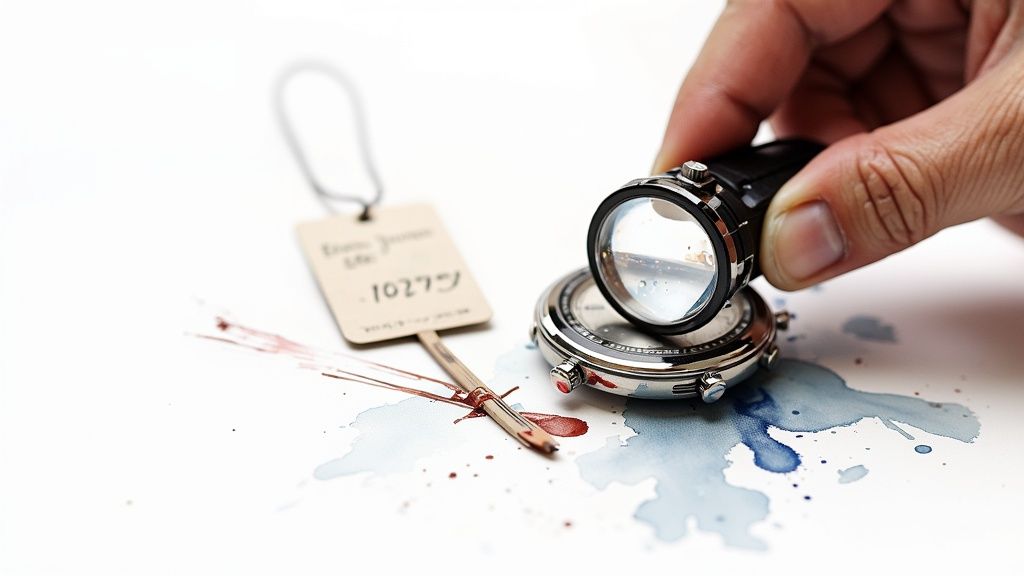 Hand holding magnifying loupe examining watch movement components with identification tag on white surface
Think of a watch's serial number as its DNA. It’s a unique identifier permanently marked on the watch when it was made. This isn't just some random code; it's the key that can unlock the watch’s entire history, from its production date and service records to, most critically, its current ownership status.
This little number is the cornerstone of due diligence in the pre-owned watch world. If you're a buyer, it's your best tool for confirming a potential purchase is the real deal and hasn't been reported stolen. For sellers, providing the serial number upfront builds instant trust and helps justify your asking price.
The Bedrock of Authenticity and Security
Running that number through a lookup serves a few crucial purposes, all of which give you peace of mind. It’s a small action with big consequences.
- Theft Verification: First and foremost, you're checking the number against international databases of stolen watches. A clean report here is non-negotiable.
- Dating the Watch: For many brands, the serial number can nail down the year of manufacture. This is invaluable for confirming that other components, like the dial or hands, are correct for that specific production period.
- Authenticity Checkpoint: While it won't catch the most sophisticated "super-fakes," it immediately flags low-quality counterfeits that often use fake or duplicated serial numbers.
A watch serial number is more than just an identifier; it’s a tangible link to the manufacturer's records and the global watch community. Ignoring it is like buying a car without checking the VIN—a risk you can’t afford to take.
Modern verification databases have totally changed the game for watch authentication. Dedicated stolen watch databases, which field hundreds of thousands of queries every year, highlight just how critical accurate serial number verification has become in the luxury market. You can run your own watch serial number lookup on StolenWatchX to check any timepiece instantly.
Finding the Serial Number on Any Timepiece
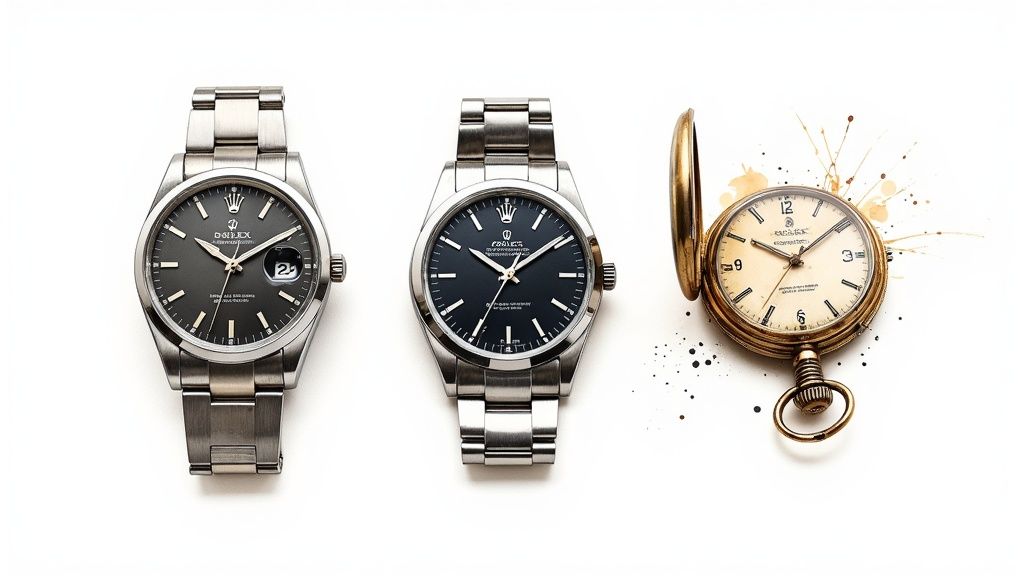 Three luxury Rolex watches displayed on white background, two steel wristwatches and one gold pocket watch
Before you can even think about running a watch serial number lookup, you’ve got to find the number itself. This can feel like a bit of a treasure hunt, since every watch brand has its favorite hiding spots for these crucial engravings. Where you’ll find it often comes down to the watch's age, style, and who made it, so there's no single magic answer.
Knowing where to look is the first real skill any serious collector or careful buyer needs. For most modern watches, the number is usually somewhere you can see it without taking anything apart. Older pieces, however, almost always demand a more hands-on approach. The trick is to go slowly, be careful, and use the right tools for the job.
Common Hiding Spots on Modern Watches
Thankfully, most manufacturers of contemporary luxury watches put serial numbers in pretty accessible places. The idea is to make them easy to verify without needing to visit a watchmaker. Rolex is a perfect example of this.
Since about 2008, Rolex has engraved the serial number on the inner bezel ring, which is called the rehaut. You can see it right through the crystal, sitting at the 6 o'clock position. For models made before roughly 2007, you have to pop the bracelet off to find the number engraved on the case, tucked between the lugs at 6 o'clock.
Other big names follow a similar logic, keeping the number on the outside of the case.
- Omega: You'll often find the serial number engraved on the back of one of the lugs. If you've got a model with an exhibition case back (a see-through back), you might spot it etched right onto the movement itself.
- Cartier: This brand makes it easy. They typically put the serial number right on the case back, usually alongside the model number. It's almost always clear and easy to read.
- Audemars Piguet: Most Royal Oak models have the serial number stamped on the case back. It’s often next to the case number, so be sure you’re looking at the longer, unique serial number.
Locating Numbers on Vintage and Pocket Watches
Diving into the world of vintage watches is a whole different ballgame. With these older timepieces, the serial number is almost always hidden inside. This was a practical choice back in the day, designed to protect the delicate engraving from a lifetime of wear and tear.
For pocket watches and older wristwatches from brands like Patek Philippe, you’ll usually find the serial number stamped on the inside of the case back. That means you have to carefully open the watch to see it. On these high-end pieces, you’ll also find a separate number engraved on the movement itself; in a perfect world, both numbers should match up in the manufacturer's archives.
A Word of Caution: Never try to open a press-fit or screw-down case back without the proper tools. One slip with a pocket knife can leave a permanent gash on the case, which can seriously tank the watch's value. When in doubt, let a professional handle it.
Essential Tools for the Search
You don’t need a full watchmaker’s bench, but a few simple tools will make this process much safer and more successful. The right gear helps prevent nasty scratches and ensures you can actually read the tiny engravings once you find them.
Your most valuable tool is a jeweler's loupe, ideally with 10x magnification. These serial numbers can be incredibly small, and a loupe lets you read them clearly. It also helps you inspect the quality of the engraving itself for any signs that it's been tampered with.
If you need to remove a bracelet, a spring bar tool is a must-have. Trying to use a small screwdriver or a knife is just asking to scratch the lugs. A proper tool has a forked tip that securely grabs the spring bar, making removal safe and easy.
For those times you absolutely must open a case back, you'll need a Jaxa-style wrench for screw-down backs or a special case back knife for snap-on ones. Honestly, this step is best left to a professional if you haven't done it before, especially with valuable or water-resistant watches. Closing it improperly can compromise the seals and lead to expensive damage down the road. Once you've safely located the number, you’re ready to begin the actual watch serial number lookup.
How to Run a Proper Serial Number Lookup
Alright, you’ve got the serial number. Now the real detective work begins. This is where that string of digits becomes a story, telling you where the watch has been and whether it’s legitimate. This isn't just about plugging a number into a search box; it’s about building a complete, reliable profile of the watch in front of you.
Your first move, always, should be to check it against stolen watch databases. Think of these platforms as the front line in the fight against theft in our community. They are an absolutely essential safeguard for buyers, sellers, and collectors alike.
Start with Stolen Watch Databases
The biggest risk with any pre-owned watch is that it's stolen property. Running a watch serial number lookup through a dedicated database isn't optional—it's a must-do. These databases compile reports from law enforcement, insurance companies, and individual victims from all over the world. StolenWatchX lets you check any serial number against a comprehensive global registry.
The search interface is usually dead simple, just asking for the brand and serial number.
This clean design means you can get right to the point and submit the details for verification without any fuss.
A clean report is a huge relief, while a "hit" can save you from a world of trouble. This simple check protects you from losing your money and getting tangled up in the legal mess of possessing stolen goods. For a quick and easy first pass, you can also check our stolen watch database to see if the serial number has been flagged.
I can't stress this enough: never, ever skip this step. It doesn’t matter how much you trust the seller. A clean report from a reputable database is one of the strongest pieces of evidence you can have that a watch is not currently listed as lost or stolen.
Dive into Brand Archives and Production History
Once you’ve cleared the theft check, the serial number becomes your key to unlocking the watch’s manufacturing history. This is how you confirm its age and authenticity. Many watchmakers, especially the ones with a rich heritage, keep detailed archives that can link a serial number to a specific production year, or sometimes even the original date of sale.
For vintage American brands, this can be surprisingly straightforward. Back in the early 20th century, companies like Elgin, Illinois, and Waltham used extensive serial number systems for quality control. They kept meticulous records from the 1900s-1950s, and today, incredible online resources have digitized millions of these entries. You can often find not just the production year but also the specific grade and jewel count of a watch. You can learn more about these historical records and why they are so valuable to collectors.
Here are a few avenues to explore for dating a watch:
- Manufacturer Archives: Top-tier brands like Patek Philippe and Vacheron Constantin offer a service called an "Extract from the Archives." It's an official document detailing the watch's original specs, though it usually costs a few hundred dollars and can take weeks or months to arrive.
- Specialized Databases: For American-made pocket watches, the Pocket Watch Database is an absolute goldmine. Punch in a serial number from an Elgin, Hamilton, or Waltham, and you'll get a detailed report almost instantly.
- Brand-Specific Charts: For brands like Rolex, dedicated collectors have spent decades compiling charts that link serial numbers to production years. These are incredibly useful for dating watches made before 2011, which is when Rolex switched to randomized serials.
Cross-Reference with Community Knowledge
The final piece of the puzzle is tapping into the collective wisdom of the watch community. Online forums and collector groups are treasure troves of hands-on experience and expert insights. This is where you can sanity-check what you’ve learned from official sources against real-world examples.
You can often get great feedback by posting an anonymous query (without revealing the full serial number, of course). For instance, you could ask something like, "Looking at a Rolex Submariner with a G-series serial. Does this dial configuration look right for a 2010 model?" You’d be surprised how often a seasoned collector can spot a tiny inconsistency that a database would completely miss.
These are some of the best places to start:
- RolexForums: The definitive hub for anything Rolex. You'll find endless discussions on serial number ranges, bracelet codes, and dial variations.
- Omega Forums: If you're into Omega, this is your spot. The depth of knowledge on vintage Speedmasters and Seamasters here is incredible.
- WatchUSeek: A massive, all-purpose watch forum with dedicated sub-forums for just about every brand you can think of.
By weaving together these three approaches—database checks, historical research, and community feedback—you create a complete picture of the watch. This turns a simple watch serial number lookup from a single task into a powerful verification strategy, giving you the confidence you need to make a smart decision.
Decoding the Results and Spotting Red Flags
So you've run the serial number, and now you have a result. But what does it actually mean? A simple "found" or "not found" is just the start of the story. The real art is learning how to read between the lines and spot the kinds of red flags that a database search alone will never catch.
Getting a direct hit on a stolen watch registry is the most clear-cut outcome you can have. It’s an instant, no-questions-asked dealbreaker. There's zero grey area here—you walk away from the deal. If the situation warrants it, you should also consider alerting the platform or even the authorities. This is exactly why a database check should always be your first move.
Beyond a Simple Pass or Fail
But let's be honest, it's rarely that simple. Most of the time, you’ll either get a clean report or, even more confusingly, no result at all. A clean slate is good news, of course, but it’s not a golden ticket of authenticity. This is where your own expertise and a keen eye become your most valuable assets.
A "no result" finding can point to a few different scenarios:
- The watch is perfectly legitimate and has simply never been reported stolen. This is the best-case, and most common, outcome.
- The timepiece is quite old or from a smaller, niche brand. Record-keeping, especially before everything went digital, can be spotty.
- The watch was stolen, but the owner never reported it to a public database. This is the dangerous information gap that every buyer needs to be aware of.
A clean database check isn't the finish line; it's the green light to continue your investigation. It tells you the number isn't flagged, but now you need to prove that the number actually belongs to the watch in your hands.
Think of yourself as shifting from a data-checker to a detective. Your job now is to hunt for tiny inconsistencies that could expose a counterfeit or a dreaded "Frankenwatch"—a watch cobbled together from parts of other, often unrelated, timepieces.
This decision tree gives you a basic roadmap. If the serial number checks out, your work isn't done. And if you have any doubt at all, it's time to call in an expert.
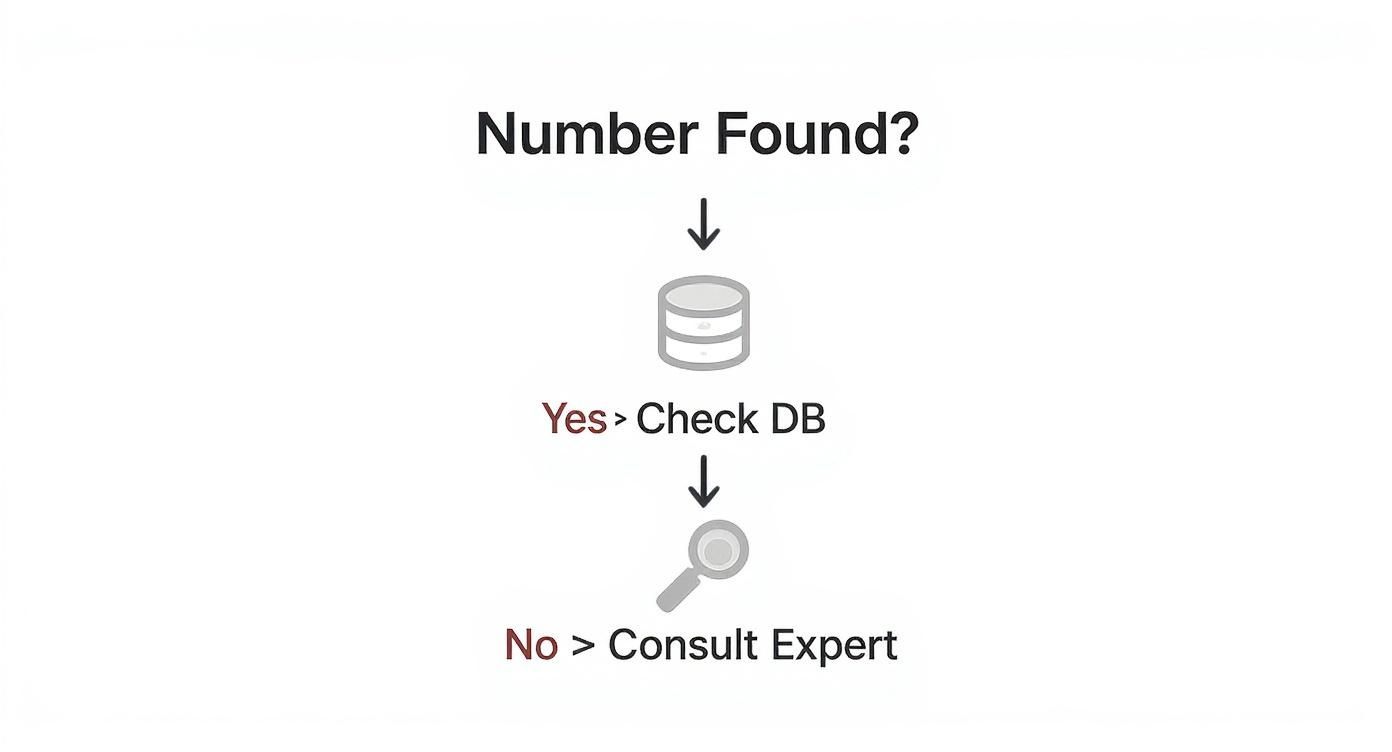 Flowchart showing database check process for found numbers leading to expert consultation
The key takeaway here is that a successful database lookup is just one checkpoint. The real work involves a much closer, hands-on inspection of the watch itself.
Here is a quick guide to help you make sense of your search results and decide on the best course of action.
Interpreting Your Lookup Results and What to Do Next
| Lookup Result | What It Means | Recommended Action |
|---|---|---|
| "Stolen" Match | The serial number is listed in one or more stolen watch databases. This is a major red flag. | Do not proceed with the transaction. Walk away immediately. Consider reporting the listing to the platform and/or local authorities. |
| Clean Report | The serial number is not currently flagged as stolen in the databases you checked. | Proceed with caution. This is a positive sign, but you must now verify the watch's physical details against the serial number's history. |
| No Result | The serial number does not appear in any records, either stolen or manufacturer archives. | Investigate further. This is common for vintage watches or those never reported. Deeper physical inspection and expert consultation are now critical. |
Ultimately, these results are just data points. Your next steps are what truly protect you from making a costly mistake.
Common Red Flags to Watch For
This is where you marry the digital lookup with what you can see and feel. Any conflict between the serial number's known history and the watch's physical state is a huge warning sign.
Mismatching Production Dates and Features A serial number lookup should give you a good idea of the production year. Does the watch look like it belongs to that era? For instance, if you find a serial number pointing to a 1990s Rolex, but the watch has a modern ceramic bezel that wasn't introduced until the 2000s, you have a problem. The parts don't match the period, which screams "Frankenwatch" or fake.
Sloppy or Inconsistent Engravings Legitimate manufacturers engrave with incredible precision. Grab a loupe and get up close. Red flags include:
- Shallow, faint engravings that look more like they were acid-etched instead of machine-cut.
- Numbers that are poorly spaced or aren't perfectly aligned.
- A font style that looks "off" compared to known examples from that brand and production year.
Contradictions with Paperwork If the watch comes with its original papers, the serial number on the certificate must perfectly match the one on the watch case. No excuses. Even one digit being off is a dealbreaker. Don't forget to assess the quality of the documents themselves—are there typos? Does the paper feel cheap or look freshly printed? You can dive deeper into this process by reading our guide on certificate verification.
Smarter Buying and Selling Practices
Running a serial number lookup isn't just a technical checkbox; it's the bedrock of a safe and honest transaction. Whether you're buying your first serious watch or selling a piece from your personal collection, this simple step protects everyone involved. It replaces guesswork with concrete facts, building a foundation of trust between you and the other party.
For buyers, this is where your real work begins—long before any money is on the table. Think of your due diligence as your best, and frankly, only, defense against ending up with a stolen or fraudulent watch. Don't ever feel awkward about asking for the details you need. Any seller who's on the level will respect your thoroughness.
Essential Steps for Every Buyer
Your main job is to verify the watch's identity for yourself. That means getting your hands on the serial number directly and without any doubt.
First things first, ask for clear, high-resolution photos of the serial number engraving. A blurry, distant photo is a massive red flag. Be specific: you need a well-lit, close-up shot where every digit is perfectly legible.
With the number in hand, run the check yourself. Never, ever rely on a screenshot of a report the seller sends you. Use a trusted database to confirm the watch hasn't been flagged as stolen. This step is absolutely non-negotiable.
Trust, but verify. A reputable seller will have no problem giving you the serial number to check. If they hesitate, make excuses, or send you garbage photos, that's your cue to walk away.
Beyond the lookup, ask some pointed questions about the watch’s life story. A few smart inquiries can either poke holes in their story or give you confidence in the watch’s history.
- "Can you tell me about its service history?" This tells you if it's been cared for and who did the work.
- "Are you the original owner?" Knowing the chain of ownership is crucial for provenance.
- "Does it come with the original box and papers?" Not always a deal-breaker, but their absence means you need to be even more critical.
Best Practices for Sellers
If you're on the selling side, transparency is your best friend. Being proactive builds instant trust and helps justify your asking price. Don't even wait to be asked—offer the serial number upfront. It's a clear sign you have nothing to hide.
You might even want to invest in a verification report from a service like THE WATCH REGISTER. Including a clean, third-party report with your listing shows you've done your homework and can attract serious buyers who know what they're doing. This little bit of effort can really speed up a sale.
This documentation also serves as proof that the watch has a clean title at the time of the sale, protecting you from any issues down the road. And on that note, if a watch is ever lost or stolen from you, time is of the essence. You can report a stolen watch to a global database, which is a critical step in ever seeing it again.
The Final Step: The Bill of Sale
No matter which side of the deal you're on, always, always create a detailed bill of sale. This document is the official record of the transaction, and it needs to be specific to protect both of you.
Your bill of sale must include the watch's brand, model number, and the full serial number. This creates an ironclad paper trail that ties this specific watch to this specific deal, leaving zero room for doubt about what was bought and sold.
This last piece of paper provides incredible peace of mind. For the buyer, it’s proof of legitimate ownership. For the seller, it's confirmation that the correct item was delivered as promised, closing the loop on the transfer of property.
Got Questions About Watch Serial Numbers? We've Got Answers.
When you start digging into watch serial numbers, a few questions always pop up. It doesn't matter if you're a seasoned collector or just checking your first watch—some uncertainties are universal. Getting these sorted out is the key to using that serial number for what it is: a powerful tool for verification.
Let's walk through some of the most common questions that come up during a lookup. My goal here is to give you straight, practical answers so you can move forward with confidence and make smart decisions.
Does a Clean Lookup Guarantee My Watch is Real?
This is the big one, and the short answer is a hard no. A successful serial number lookup is a critical step, but it's absolutely not a final guarantee of authenticity. Think of it as passing an important background check, not getting a certified birth certificate.
Here’s what a lookup actually confirms: that the serial number exists and is correct for that brand and model, and, crucially, that it hasn’t been flagged as stolen. The problem is, the best counterfeiters are smart. They'll often copy a real, legitimate serial number from a genuine watch and engrave it onto a fake. That means a knock-off could pass a database check without a single issue.
A clean report is your green light to proceed to the next step: a thorough physical inspection. This is where you—or a professional—look at the things fakes can't get right, like the fine details of the movement, the quality of the dial print, and the precise finishing of the case.
For any watch that represents a serious investment, the final word should always come from a certified watchmaker. They have the hands-on expertise to spot the tell-tale signs of a fake that a database check could never catch, giving you a definitive verdict.
What if a Watch Has No Serial Number?
Seeing a watch with no serial number should make you stop in your tracks. For any modern luxury watch—think Rolex, Omega, Cartier, and the like—a missing serial number is a massive red flag. Nine times out of ten, it means the number was intentionally removed, usually by polishing or grinding it off.
Why would someone do that? The most obvious reason is to conceal a stolen watch. By erasing its unique identifier, a thief hopes to make the watch untraceable and prevent it from ever showing up on a stolen-watch registry.
Now, there are a couple of rare exceptions to keep in mind.
- Very Old Antique Pieces: Some watches from the 19th or early 20th centuries simply weren't serialized by their manufacturers. It wasn't standard practice for everyone back then.
- Heavily Polished Vintage Watches: I've seen vintage pieces that have been polished so many times over 50+ years that the serial number has become incredibly faint or even completely worn away.
But let's be clear: for any modern luxury watch, a missing serial is almost always a deal-breaker. You should be extremely cautious and probably walk away, assuming it has a shady past.
How Accurate Are Those Online Dating Charts?
The accuracy of online databases for dating a watch really depends on the brand. For classic American brands like Elgin, Hamilton, and Waltham, the resources are fantastic. Tools like the Pocket Watch Database are incredibly precise because those companies kept amazing factory records, which have since been digitized. You can often nail down the exact production year.
Swiss brands are a different story. The charts you see online are usually compiled by dedicated collectors and experts over decades of observation. They are generally very reliable for getting a production year range, but they are educated estimates, not official data. Rolex, for example, has never officially released its serial number records, so all those charts floating around are the result of passionate detective work by the community.
If you need 100% certainty, the only way is to go straight to the source. Brands like Patek Philippe offer an "Extract from the Archives" service. It costs money and takes time, but they'll issue an official document detailing your watch's original production and sale date. For many high-end Swiss pieces, it's the only way to get a truly definitive answer.
Brand-Specific Stolen Watch Checks
Jump straight to the brand-specific database for the watch you're checking:
- Stolen Rolex database — Submariner, Daytona, GMT-Master, Datejust
- Stolen Patek Philippe database — Nautilus, Aquanaut, Calatrava
- Stolen Cartier database — Santos, Tank, Ballon Bleu, Panthere
- Stolen Omega database — Speedmaster, Seamaster, Constellation
- Stolen Audemars Piguet database — Royal Oak, Royal Oak Offshore
Due diligence is everything in the watch world. At StolenWatch, we offer a free database to help you check serial numbers and protect yourself from buying or selling stolen property. Keep your collection safe and transact with peace of mind by visiting https://stolenwatchx.com today.
Related Articles
View all
How Can I Check My Rolex Serial Number A Definitive Guide
Wondering how can I check my Rolex serial number? This guide details how to locate and decode your number to verify age, authenticity, and ownership history.

Your Definitive Guide to a Movado Serial Lookup
Unlock the secrets of your watch with our guide to a Movado serial lookup. Learn how to verify authenticity, check for theft, and understand your timepiece.
Your Guide to Watches Auctions Online and Spotting Fakes
Master watches auctions online with our expert guide. Learn to spot fakes, verify authenticity, and get the best deals on luxury timepieces.