Understanding Burglary Safe Ratings to Protect Your Valuables
Demystify burglary safe ratings. This guide explains UL, TL, and EN standards to help you choose the right high-security safe for your collection.
StolenWatch Team
Watch Authentication Specialist at StolenWatch
Demystify burglary safe ratings. This guide explains UL, TL, and EN standards to help you choose the right high-security safe for your collection.
When it comes to protecting your watches, a safe's burglary rating is the only thing that truly matters. Forget about how heavy it is or how thick the door looks. The real measure of security comes from brutal, standardized tests performed by independent labs. Getting this right is the single most important step you can take to secure your collection.
Why a Certified Rating is Your First Line of Defense
Imagine that gut-wrenching moment you realize your collection is gone. For any serious collector or dealer, this is more than just a bad dream—it’s a constant, background threat that demands a real security plan. The cornerstone of that plan isn't just owning a safe, but owning the right safe, one with a certified burglary rating.
It's easy to assume any big steel box is secure. But without an official certification from a respected organization like Underwriters Laboratories (UL) or its European counterpart (EN), a safe is just a metal container with a lock. It’s a promise of protection, not proof.
Theft is a Global Problem
The hard numbers on global crime tell a sobering story. Burglary isn't a vague threat; it's a statistical reality that varies wildly from one country to another. For instance, Costa Rica reports an astonishing 775.98 burglaries per 100,000 people, while Sweden and Australia also see alarmingly high rates. If you operate in any major market, this data is a wake-up call: serious physical security isn't optional. You can learn more about how crime rates differ by country and what that means for protecting your assets.
A genuine burglary rating turns a simple lockbox into a tested and proven fortress. It certifies that the safe withstood a timed assault by professionals using a whole arsenal of tools—everything from sledgehammers and high-speed drills to cutting torches.
A safe without a rating is a gamble. A safe with a rating is a security investment backed by hard facts, telling you exactly how long it will hold up when seconds count.
This guide will break down what these critical ratings actually mean, cutting through the jargon to give you practical, real-world knowledge. You’ll understand what labels like "TL-15" and "EN 1143-1" signify for the safety of your watches, so you can choose a safe that genuinely protects your passion. And if the worst-case scenario ever happens, we’ll show you how StolenWatch acts as your essential second layer of defense, creating an ironclad inventory to help recover what’s yours.
Decoding the Language of Safe Security
Stepping into the world of high-security safes can feel like learning a new language. You’re suddenly faced with a confusing alphabet soup of codes like "TL-15," "TRTL-30x6," and "EN 1143-1 Grade II." These aren't just random labels; they are the grammar of security, telling a precise and crucial story about a safe's ability to protect what you value most.
Think of burglary safe ratings like a car's official crash-test results. They provide a standardized, objective measure of how a safe performs under extreme, simulated attack conditions. A safe without a rating is a gamble—it might look tough on the outside, but you have no verified proof of how it will hold up when it really matters.
The diagram below shows how a certified physical safe forms the foundation of total asset protection, with digital recovery tools like StolenWatch providing a critical second layer.
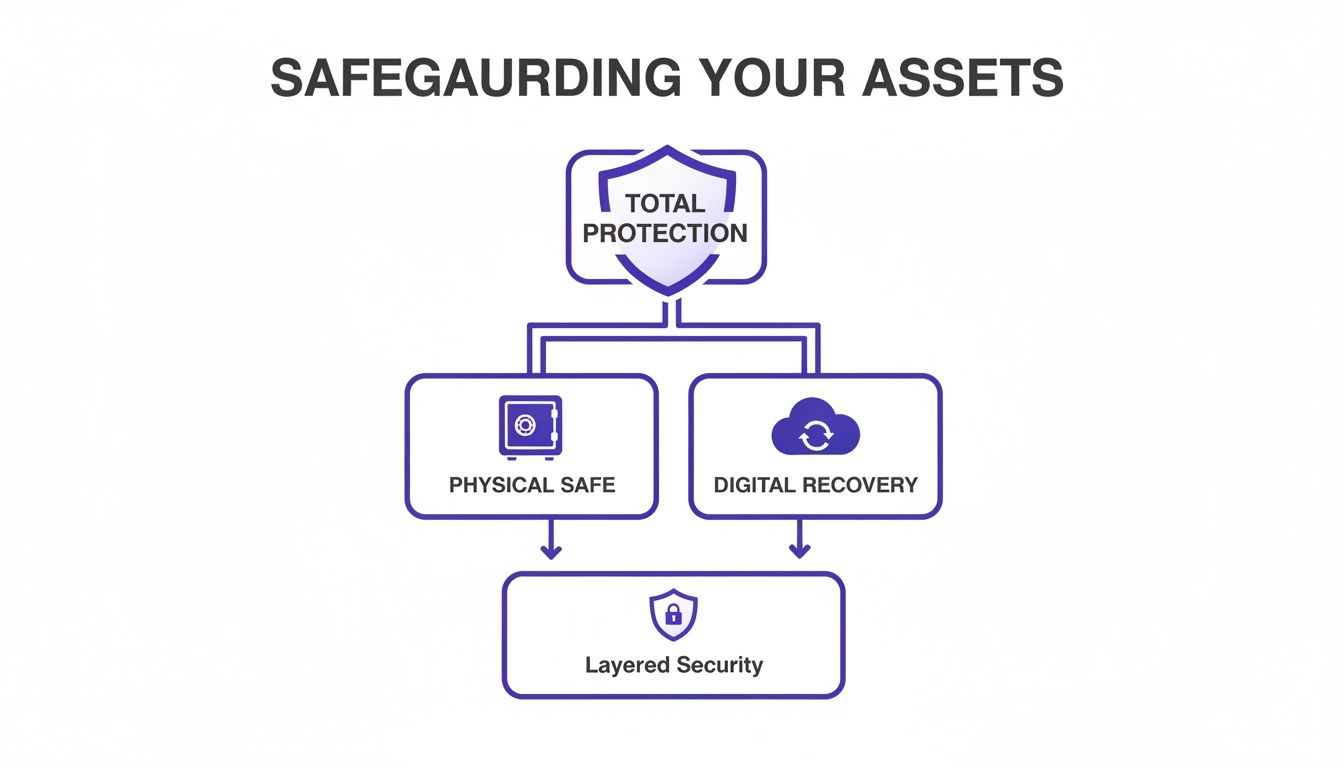 A flowchart illustrating total asset protection through physical safe and digital recovery, resulting in layered security.
While a top-tier safe is your first and best line of defense, a complete security strategy must also include a plan for what happens if that physical barrier is ever breached.
The Two Titans of Safe Certification
Globally, two independent organizations are the gold standard for testing and certifying safes: Underwriters Laboratories (UL) in the United States and the European Certification Body (ECB-S), which handles the EN standards in Europe. When you see their label on a safe, it’s not a marketing sticker—it's a guarantee that the safe has survived a brutal, real-world attack simulation conducted by experts.
These certifications provide peace of mind, knowing your safe isn't just a heavy box, but a proven security device.
Understanding the UL Rating System
The UL rating system is famous for its direct and descriptive codes. When you see a UL label, you’re essentially reading the final score of a controlled break-in attempt by professional safe-crackers.
- TL (Tool-Resistant): This is the baseline rating. It means the safe door resisted entry from a battery of common picking tools, mechanical drills, grinders, and sledgehammers.
- TR (Torch-Resistant): This signifies that the safe can also withstand an attack from a high-temperature cutting torch, a common tool in sophisticated burglaries.
- TX (Explosive-Resistant): Reserved for the highest-security commercial safes, this rating confirms the safe can resist a specific quantity of nitroglycerin or other explosives.
The number following these letters is the most important part of the rating. For instance, a TL-15 rating means the safe door withstood a concentrated attack for 15 minutes of "net working time." This isn't a simple 15-minute countdown. It's the total time the tools are actively grinding, drilling, or prying the safe. A real-world attack, including setup, planning, and cooling-off periods, could take hours.
A TL-30 rating provides double the tool resistance of a TL-15. The "x6" suffix, as in TL-30x6, means the safe offers that same 30-minute protection on all six sides—not just the door. This is a critical distinction for high-value collections where a thief might try to attack the walls or floor of the safe.
Interpreting European EN 1143-1 Grades
The European system, governed by the EN 1143-1 standard, uses a different but equally rigorous methodology. Instead of measuring time directly, it assigns a "resistance unit" (RU) score based on tool types and attack duration, then classifies safes into grades.
These grades are incredibly practical because they directly correlate to an insurable cash value, making it simple for insurers and owners to match a safe to the value of its contents.
- Grade 0: Offers a basic level of protection for lower-value items.
- Grade I to Grade V: These represent a significant leap in security, with each subsequent grade offering roughly 50% more resistance than the one before it. A Grade V safe is an extremely high-security unit suitable for substantial commercial assets.
The higher the grade, the longer the safe held up during testing, and the higher the value an insurance company will typically cover.
UL vs EN 1143-1 Burglary Ratings at a Glance
To help clarify the differences, this table provides a side-by-side look at the most common ratings from both UL and European standards.
| Rating | Testing Body | Meaning of the Rating | Common Tools Resisted | Ideal for Protecting |
|---|---|---|---|---|
| TL-15 | UL | Withstands tool attacks on the door for 15 minutes. | Hand tools, picking tools, drills, grinders, sledgehammers | Small collections, documents, moderate cash amounts |
| TL-30 | UL | Withstands tool attacks on the door for 30 minutes. | More advanced versions of common burglary tools | High-value personal collections, jewelry, business assets |
| TL-30x6 | UL | Withstands tool attacks on all six sides for 30 minutes. | All of the above, from any angle of attack | Watch dealers, jewelers, irreplaceable collections |
| EN 1143-1 Grade I | ECB-S | Rated for a specific insurance cash value (e.g., ~$10,000) | Basic hand and power tools | Personal use, entry-level luxury items |
| EN 1143-1 Grade III | ECB-S | Higher insurance cash rating (e.g., ~$45,000) | More sophisticated power tools, extended attack time | Serious personal collectors, small business inventory |
| EN 1143-1 Grade V | ECB-S | Very high insurance rating (e.g., ~$150,000+) | Advanced cutting, drilling, and thermal attack tools | Commercial vaults, high-end jewelers, significant cash holdings |
This comparison highlights how both systems offer a clear progression of security, allowing you to choose the right level of protection for your specific needs. For a more detailed breakdown, you can explore our complete guide to UL safe ratings, which dives even deeper into the technical specifics.
Ultimately, whether it’s a UL or EN label, these burglary safe ratings transform a purchase from a guess into a calculated security decision. They are the language of true protection, ensuring the safe you choose is a battle-tested guardian, not just a heavy box with a hopeful promise.
Inside the Lab: How a Safe Earns Its Rating
Picture a team of professional safe-crackers given a brand-new safe and a mission: break into it as fast as possible. They’re armed with everything from pry bars and carbide drills to high-speed grinders and cutting torches. This isn't a scene from a heist movie; it's the intense, controlled reality of how a safe gets its official burglary safe rating.
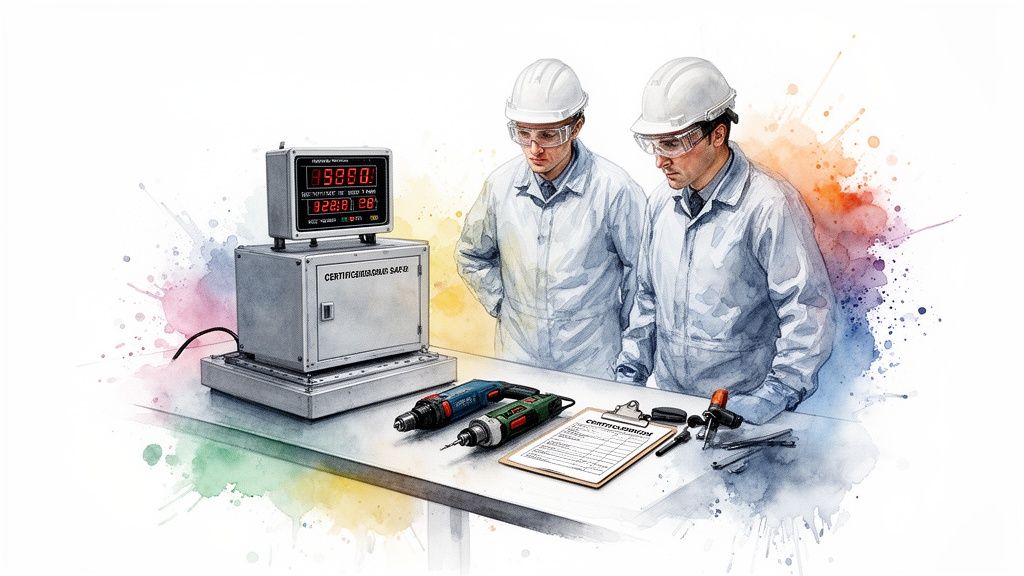 Two engineers in hard hats and safety glasses examine equipment and tools in a watercolor illustration.
These rigorous tests, conducted by independent bodies like Underwriters Laboratories (UL), are designed to simulate a worst-case scenario. The testing team gets the safe’s full blueprints and schematics, letting them map out potential weak spots before the attack even starts. They aren't fumbling in the dark; they are executing a planned, expert assault.
The All-Important Net Working Time
The single most misunderstood concept in the world of safe ratings is "net working time." This is the crucial metric that separates real security from clever marketing. It's the reason a TL-15 safe isn't designed to stop a burglar for just 15 minutes.
When a test begins, a stopwatch starts, but it only runs when a tool is physically attacking the safe. If the team stops to change a drill bit, check the blueprints, let a tool cool down, or clear away debris, the clock stops. A TL-15 rating means the safe survived 15 full minutes of focused, relentless tool-on-metal attack time.
A safe's rating isn't about the total duration of the break-in attempt, which can stretch for an hour or more. It reflects the pure, concentrated time of destructive force the safe can endure from skilled professionals who know exactly where to strike.
This distinction is massive. An amateur burglar, working without specialized equipment or intimate knowledge of the safe's construction, would likely need exponentially more time and effort to achieve what the lab technicians do in mere minutes of net working time.
The Tools of the Trade
The severity of the test is also dictated by the tools allowed. Lower-level ratings face a specific, limited arsenal, while higher ratings must withstand a much more formidable collection of equipment. The goal is to replicate what a sophisticated criminal might bring to the job.
- For a UL TL-15 Rating: Testers get common hand tools, picking tools, pry bars, hammers, and high-speed carbide drills.
- For a UL TL-30 Rating: The toolbox expands to include more powerful gear like abrasive cutting wheels and power saws.
- For a UL TRTL-30 Rating: This test introduces the ultimate safe-cracking weapon: the oxy-acetylene cutting torch, capable of slicing through thick steel like butter.
To pass, the safe has to resist these tools for the entire net working time. A successful test means the technicians couldn't create a six-square-inch opening through the door (or a 96-square-inch opening through the body on "x6" models) or manipulate the lock.
The Pass or Fail Verdict
There's no partial credit in a burglary rating test. A safe either passes and earns its certification label, or it fails and is sent back to the manufacturer for a redesign. This simple, binary outcome is what gives the rating its power and reliability.
When you see a UL or EN label on the inside of a safe's door, it’s not just a sticker. It's a testament—proof that this specific model withstood a brutal, calculated assault designed to make it fail. It’s a verified benchmark of its resilience, confirming that its engineering, materials, and construction held up under extreme pressure, making it a worthy guardian for your valuables.
Choosing the Right Safe Rating for Your Collection
<iframe width="100%" style="aspect-ratio: 16 / 9;" src="https://www.youtube.com/embed/9u-asS7Ldys" frameborder="0" allow="autoplay; encrypted-media" allowfullscreen></iframe>Picking the right burglary safe rating isn't just about grabbing the one with the highest numbers. It’s a strategic decision that has to balance the value of your watches, your personal risk profile, and—most importantly—your insurance requirements.
Think of it like buying tires for a car. You wouldn't put slick racing tires on a truck you use for off-roading. The same logic applies here. The "best" safe is the one that’s perfectly matched to your specific collection and your life. Now, let's translate that technical knowledge into a practical choice that protects your assets without going overboard.
For the Individual Collector
If you're a passionate collector with a growing stable of watches, a safe with a UL TL-15 rating usually hits the sweet spot. This certification gives you a serious defense against the kind of smash-and-grab burglaries that make up the vast majority of residential break-ins. It's a clear signal that your collection is behind a barrier proven to stand up to expert tool attacks for a meaningful amount of time.
Another excellent option, particularly common in Europe, is a safe rated EN 1143-1 Grade II or III. These grades are often tied directly to specific insurance cash limits, which makes getting your collection properly covered much more straightforward.
For most personal collectors, these ratings provide:
- A solid balance of cost and security, delivering robust protection without the five-figure price tag of commercial-grade units.
- Easy insurance compliance, as they typically meet or exceed what most policies for personal jewelry and watches demand.
- A powerful deterrent effect, because a professionally installed, certified safe tells opportunistic thieves to move on to an easier target.
Before you buy anything, call your insurance agent. This is non-negotiable. They will tell you the minimum rating required to insure your collection's value. This single phone call removes all the guesswork and ensures your policy will actually pay out if the worst happens.
For Dealers and High-Value Collections
Once you're protecting a commercial inventory or a personal collection deep into the six or seven figures, the game changes. The security stakes are much, much higher.
For luxury watch dealers and top-tier collectors, a UL TL-30 rating should be the absolute starting point. This certification doubles the tool resistance time of a TL-15, offering a much stronger defense against a planned, professional attack where thieves come prepared.
Even better is the UL TL-30x6. The "x6" is critical—it means the safe provides that same 30 minutes of protection on all six sides, not just the door. Sophisticated attackers know that the body of a safe can be its weakest link, and this rating closes that loophole.
For a dealer or a high-net-worth individual, a safe isn't just a storage box; it's a non-negotiable business asset and a core part of risk management. Failing to meet insurance mandates with the correct rating can result in a denied claim, turning a robbery into a catastrophic financial loss.
These higher ratings are essential for stopping professional criminals and satisfying the stringent demands of insurers. For a more detailed look at specific models, our guide to the best home safes offers in-depth reviews and comparisons.
Recommended Safe Ratings by Collection Value and Type
The table below offers a practical starting point for matching a safe rating to your specific needs. Use it as a guide, but always confirm the final requirements with your insurance provider.
| User Profile | Typical Collection Value | Recommended Minimum UL Rating | Recommended Minimum EN 1143-1 Grade | Key Considerations |
|---|---|---|---|---|
| Personal Collector | Up to $150,000 | TL-15 | Grade II | Focus on balancing cost with strong residential burglary protection. |
| Serious Collector | $150,000 - $500,000 | TL-30 | Grade III | Protection against more determined, tool-based attacks is crucial. |
| High-Net-Worth Collector | $500,000 - $1,000,000+ | TL-30x6 | Grade IV or V | Six-sided protection is essential; criminals may attack the safe body. |
| Small Dealer / Jeweler | Up to $1,000,000 | TRTL-30x6 | Grade V | Torch and tool resistance is necessary for commercial-level risk. |
| Large Dealer / Vault | Multi-million dollar inventory | TRTL-60x6 or Modular Vault | Grade VI or higher | Requires the highest level of protection against all forms of attack. |
Ultimately, this table helps you enter the conversation with a safe dealer or insurer armed with the right knowledge, ensuring you get the protection your collection deserves.
When a Vault Is the Right Answer
For the absolute highest level of security, especially for large dealer inventories or truly irreplaceable personal collections, a modular vault is the logical next step.
These aren't the bank vaults you see in movies. Modern modular vaults are built with high-security panels, often carrying ratings like UL Class M or Class 1, that allow you to turn an entire room into a fortress.
Modular vaults offer some huge advantages:
- Scalable Security: You can design the vault to fit your exact space and inventory needs, and it can even be moved to a new location if necessary.
- Unmatched Resistance: They provide comprehensive protection against advanced tool, torch, and sometimes even explosive attacks.
- Climate Control: Vaults can be easily equipped with specialized HVAC systems to preserve the delicate mechanisms of vintage and complicated timepieces.
Choosing the right safe or vault rating is where all the technical details become real-world security. By carefully matching the rating to your collection's value and working hand-in-hand with your insurer, you create a layer of protection that is both physically effective and financially sound.
Beyond the Rating: How Proper Installation Creates Real Security
A top-tier burglary safe rating tells you a safe can take a beating. It’s engineered to resist drills, torches, and pry bars for a specific amount of time. But what happens if a burglar decides not to play that game? The single biggest mistake I see owners make is thinking the rating on the door is the end of the story.
True security only kicks in when that safe becomes an immovable part of your home or business. A high-rated safe just sitting on the floor is nothing more than a heavy box. Thieves won't waste time trying to crack it on your property; they’ll just wheel it out and take it to a place where they have all the time in the world.
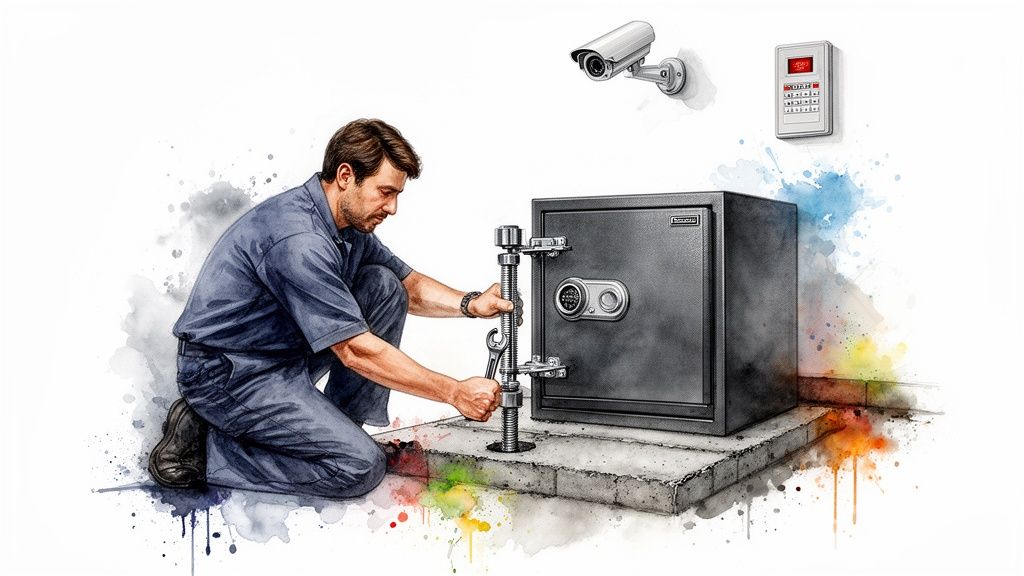 A technician in blue uniform secures a large safe to the floor with tools, watched by a security camera and keypad.
This final step—the installation—is what turns a rated product into actual, real-world protection. It's the critical link that makes all that engineered steel and complex testing worth a damn.
The Foundation of Physical Security
Bolting down your safe isn't a suggestion; it’s non-negotiable. Look at any certified safe, and you'll find pre-drilled anchor holes. They’re there for a reason. Ignoring them basically throws away a huge chunk of your investment. The goal is simple: make it harder and louder to rip the safe out than it would be to break into it.
A professional installer knows that it all starts with a solid foundation.
- Concrete is King: There's no substitute for bolting a safe directly into a concrete slab. It provides the strongest anchor you can get. Wood joists, on the other hand, can be sawed or split, making them a much weaker alternative.
- Location, Location, Location: You want a spot that’s both hidden and structurally sound. The master bedroom closet is the first place a burglar looks, so think outside the box. A corner in the basement or garage, where the safe can be anchored to the floor and a wall, provides far more stability.
- Professional Expertise: You could try to install it yourself, but a pro brings experience. They’ll use the right hardware for your specific floor type and torque the bolts to the manufacturer's exact specifications. That’s how you get maximum resistance.
Layered Security: Your Complete Protective Ecosystem
Even a perfectly installed safe shouldn't work alone. The most security-conscious collectors and dealers I know think in layers. They create multiple barriers that a criminal has to defeat, one after the other. Your safe is the last stand, but it needs backup.
A safe is your physical fortress, but it’s most effective when supported by alarms, surveillance, and a digital recovery plan. Each layer forces a thief to spend more time, make more noise, and take more risks.
This is where a modern, holistic security strategy comes into play. Your physical defenses need a solid digital plan for what happens if the unthinkable occurs. To get more ideas on safeguarding your collection, check out our in-depth guide on how to properly store your Rolex watches.
A complete protective ecosystem looks like this:
- Perimeter Defense: Alarms on all doors and windows create the first alert.
- Internal Surveillance: Security cameras act as a powerful deterrent and capture crucial evidence if a break-in happens.
- The Physical Fortress: Your professionally installed, certified safe secures your most valuable assets.
- Digital Recovery: A detailed, up-to-date inventory is your final, essential line of defense.
This is where StolenWatch becomes an indispensable partner. By keeping a detailed log of your collection—serial numbers, high-res photos, purchase documents—you're not just organizing. You're building a powerful tool for law enforcement and insurance agents. If your physical security is ever compromised, your StolenWatch inventory gives you the critical data to instantly alert the global market, maximizing the chances of recovery and truly completing your security ecosystem.
How to Spot Fake Ratings and Verify Authenticity
In the world of high-value safes, what you see isn't always what you get. Misleading claims can lead to devastating losses, so knowing how to separate genuine, hard-earned ratings from empty marketing fluff is crucial. A real burglary safe rating is a badge of honor, proof that the safe survived a brutal, professional attack.
The first thing to do is tune out the noise. Vague terms like "burglar-resistant," "theft-proof," or "high-security" mean absolutely nothing without a certification to back them up. They’re red flags. A legitimate rating is specific and verifiable, like "UL TL-15" or "EN 1143-1 Grade II." Anything else is just a sales pitch.
Inspecting the Certification Label
The only true proof of a safe's rating is its official certification label. This isn't just a flimsy sticker slapped on the box. It’s a permanent metal plaque or plate, almost always found on the inside of the safe's door. This label is your guarantee that the safe you're looking at is the real deal—one that has been independently and rigorously tested.
For a UL-certified safe, look for a metal plate that clearly shows:
- Underwriters Laboratories: The full name of the organization that performed the test.
- Burglary Classification: The exact rating, such as "TL-15" or "TL-30x6".
- A Unique Serial Number: This number allows you to verify the safe directly with UL if you ever need to.
An EN 1143-1 label, often from a European body like ECB-S, will have a similar format. It will feature the certifier's logo, the specific grade (e.g., "Grade III"), and the standard it was tested against, "EN 1143-1." If a safe is missing this physical plate, walk away. No matter what the seller or the website says, you have to assume it's not certified.
Think of an authentic certification label as a safe's diploma. It’s the physical evidence that it didn't just show up for class—it passed the final exam. Without it, you’re relying on trust alone, and that’s a terrible security strategy.
Don't be afraid to put your dealer on the spot. Ask them to point out the UL or ECB-S label on the safe you're considering. If they get defensive, change the subject, or start talking about a "factory rating," it’s a major warning sign. A "factory rating" is just an unverified, in-house claim that holds no weight.
A reputable dealer will be proud to show you the official certification and explain what it means. Your collection is far too valuable to be protected by an empty promise. You need proven, certified security.
Common Questions About Burglary Safe Ratings
Once you've narrowed down your choices, a few final questions always seem to pop up. Let's tackle some of the most common ones collectors ask so you can lock in your decision with confidence.
What Is the Difference Between a Fire Rating and a Burglary Rating?
This is easily the most important thing to get right. A fire rating means the safe can protect its contents from extreme heat and smoke. A burglary safe rating, on the other hand, means it can stand up to a physical attack from tools. The materials used for each are polar opposites.
Fire safes are packed with a thick, puffy insulation that’s brilliant at keeping heat out but crumbles like drywall against a pry bar. High-security burglary safes are built with solid steel plates and super-dense concrete composites—terrible for insulation, but fantastic for stopping drills and grinders. While you can find high-end safes that do both, never, ever mistake a fire-only safe for a security container. For valuable watches, the burglary rating is what matters most.
Does a Heavier Safe Mean It Is More Secure?
Not always. It's a common assumption, but weight can be deceptive. While the big-league safes with TL ratings are monstrously heavy because of all the steel and dense composites, weight by itself is a poor measure of security. Some manufacturers just fill their safes with cheap materials like gypsum board to make them feel substantial.
That kind of filler adds a lot of weight and even offers some fire protection, but it falls apart the second it meets a sledgehammer. The only thing you can truly rely on is the official UL or EN 1143-1 certification label. Don’t judge a safe by its heft; judge it by its tested and proven rating.
A certified rating from a recognized third-party lab is the only true measure of security. Weight can be misleading, but a UL or EN label is a guarantee of performance under pressure, backed by rigorous, standardized testing.
Can I Trust a Safe Rating from an Unknown Brand?
You should focus on who did the testing, not the brand name on the front. A rating from a world-renowned third party like Underwriters Laboratories (UL) or the European Certification Body (ECB-S) is the real seal of approval. These organizations don't play favorites; they run impartial, standardized tests that hold every manufacturer to the exact same tough standard.
Be immediately suspicious of vague claims like "factory rated" or "in-house tested." That’s just the company grading its own homework. The brand could be a household name or a total newcomer—if it has a genuine UL or EN label on the inside of the door, you can trust the burglary safe ratings it claims.
Where Is the Best Place to Install My Safe?
The perfect spot is solid, out of sight, and allows for rock-solid anchoring. A concrete floor in a basement or garage is the gold standard, giving you the best surface to bolt the safe down so it’s virtually impossible to haul away.
Try to avoid the obvious places burglars check first, like the master closet or a home office. A forgotten corner in a utility room or a cluttered section of the basement is a much smarter choice. For the ultimate stability, find a spot where you can anchor the safe into both the floor and a wall.
Your physical security is your first line of defense, but a digital inventory is your crucial backup. With StolenWatch, you can log your entire collection, creating an ironclad record that helps law enforcement, insurers, and the global watch community identify and recover your assets if the worst ever happens. Protect your passion from every angle by registering your collection at https://stolenwatchx.com.
Related Articles
View all
A Buyer's Guide to Understanding UL Safe Ratings
Unlock the meaning of UL safe ratings. This guide helps you decode burglary ratings like RSC and TL-30 to choose the right safe and protect your assets.

Check Titan Watch Serial Number: Verify It's Original
Learn how to check a Titan watch serial number to confirm it's original and hasn't been reported stolen. Step-by-step guide with location and verification tips.

How to Obtain a Certificate of Authenticity for a Watch
Learn how to obtain a certificate of authenticity for a watch, what documents matter, and why a stolen-watch check should come before any certificate request.