A Buyer's Guide to Understanding UL Safe Ratings
Unlock the meaning of UL safe ratings. This guide helps you decode burglary ratings like RSC and TL-30 to choose the right safe and protect your assets.
StolenWatch Team
Watch Authentication Specialist at StolenWatch
Unlock the meaning of UL safe ratings. This guide helps you decode burglary ratings like RSC and TL-30 to choose the right safe and protect your assets.
UL safe ratings are independent, third-party certifications that tell you exactly how long a safe can hold up against a professional attack. Think of it like a chronometer certification for a luxury watch—it’s not just a sticker. It's a proven mark of performance under extreme pressure, ensuring the security you're paying for is the security you actually get.
Why UL Ratings Are the Gold Standard in Security
When you buy a safe, you’re not just buying a heavy steel box; you’re buying peace of mind. But how can you be sure that feeling is justified? Without a trusted benchmark, you’re left relying on the manufacturer's own marketing claims. This is exactly where Underwriters Laboratories (UL) brings much-needed clarity.
A UL rating is the final word on a safe's ability to fend off a sophisticated, professional attack. It means the safe has been put through a grueling, hands-on test by expert technicians whose entire job is to break into it using a specific set of tools and techniques.
The Two Pillars of Protection: Burglary and Fire
The first thing to get straight when choosing a safe is that protection isn't a one-size-fits-all deal. UL issues completely separate ratings for two very different threats. A safe that’s great at one isn't necessarily good at the other.
- Burglary Ratings: These certifications, like RSC or TL-30, measure a safe's raw physical strength against attacks from tools like drills, grinders, and torches. This is the rating that matters most when you're protecting valuables like watches from theft.
- Fire Ratings: These tell you how long the inside of the safe can stay below a specific temperature (usually 350°F) during a house fire. This is absolutely critical for protecting paper documents, cash, or sensitive electronics from heat damage.
A common and costly mistake is assuming a top-tier fire safe will also stop a determined thief. While it might deter a casual smash-and-grab, it won’t stand up to a pro. For high-value assets, a dedicated UL burglary rating is non-negotiable.
A Legacy of Trust and Verification
Founded way back in 1894 as the Underwriters' Electrical Bureau, UL quickly became a global force in safety science. They published their first standard for 'Tin Clad Fire Doors' in 1903 and haven't stopped since. By the mid-20th century, UL was certifying over 400,000 products a year, including safes with the kind of robust burglary ratings that help protect against the staggering $1.5 billion in annual global luxury watch thefts. You can learn more about the history of this safety organization on Wikipedia).
This long, proven history of independent testing is why UL safe ratings are relied upon by insurance companies, businesses, and serious collectors alike. Getting a handle on what these ratings mean—from basic residential security to professional-grade tool resistance—is the first step to making a truly smart decision to protect what's yours.
Navigating the Tiers of Burglary Protection
Knowing you need a burglary-rated safe is a great start, but it's crucial to understand that not all ratings are the same. Think of it like watches: they range from reliable daily timepieces to intricate "grand complication" masterpieces. UL safe ratings work similarly, scaling from solid residential security to nearly impenetrable commercial protection. This hierarchy exists for a reason—to offer a tested and proven solution for every level of risk.
This chart gives you a bird's-eye view of the main UL safe ratings, clearly separating the worlds of burglary and fire protection.
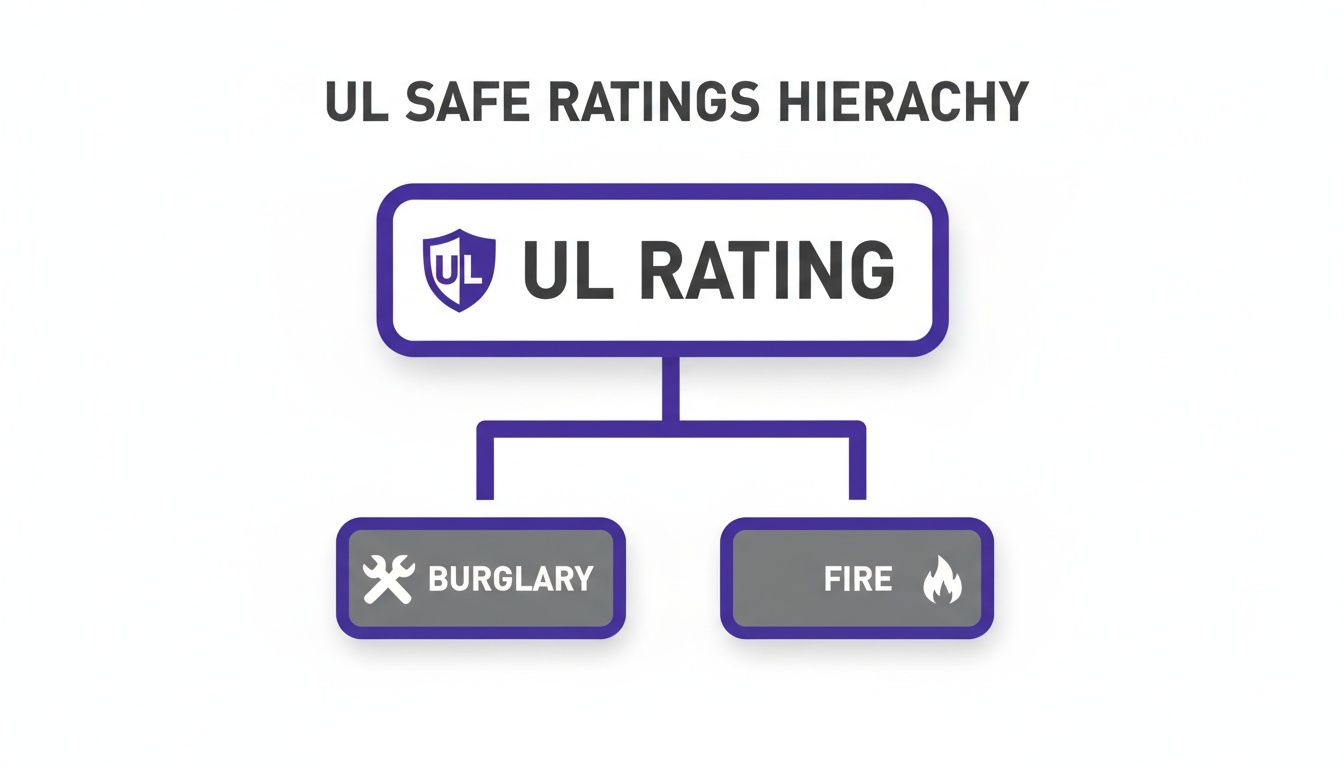 A visual hierarchy chart illustrating UL safe ratings, showing categories for burglary and fire protection.
As you can see, these two paths are entirely different. A safe built to withstand a fire isn't necessarily built to stop a burglar, and vice versa. That’s why zeroing in on the right type of rating for your specific needs is so important.
RSC: The Standard for Home Collections
For home use, the most common certification you’ll find is the Residential Security Container (RSC). This rating confirms a safe can fend off a determined attack by one person using common household tools for a set period. It's the baseline for anyone serious about securing their valuables at home.
The original RSC standard was a single benchmark. UL updated it to keep pace with more sophisticated burglary tools and techniques, which is vital for protecting modern collections from modern threats.
In early 2018, UL took its classic RSC rating and expanded it into three levels: RSC I, II, and III. This wasn't just a random change; it was a direct answer to the evolving methods criminals use, especially when targeting high-value goods like luxury watches.
The original RSC standard is now what we call RSC Level I. It requires a safe to resist 5 minutes of focused attack from tools like hammers, pry bars, and screwdrivers. The updated standards brought modern threats into the picture, including powerful battery-operated drills with carbide bits. You can read about the new UL RSC Level II rating and its implications to see just how significant this update was for the industry.
TL and TRTL: Professional-Grade Protection
Once the value of what you're protecting climbs, your security has to climb with it. That's where professional-grade UL safe ratings enter the scene. These are engineered to stop experienced criminals who show up with specialized equipment.
-
TL-Rated Safes (Tool-Resistant): "TL" is short for tool resistance. The number that comes after it, like TL-15 or TL-30, tells you the "net working time" in minutes that the safe door can withstand a full-frontal assault from UL's expert engineers. And they bring the heavy stuff. A TL-30 safe is tested to survive 30 minutes of punishment from carbide drills, high-speed grinders, and sledgehammers. This rating is often the bare minimum required by insurance companies for covering significant jewelry or watch collections.
-
TRTL-Rated Safes (Torch-and-Tool-Resistant): Now we're talking about the next level of defense. A TRTL-rated safe is tested against everything from the TL test plus high-temperature cutting torches. This dual resistance makes them incredibly tough to crack and the go-to choice for safeguarding extremely high-value assets.
Picking the right rating isn't about buying the toughest safe on the market. It's about smart risk management—matching the protection level to the value of what's inside. An RSC-rated safe is a fantastic choice for a growing collection. But once that collection's value hits a certain point, upgrading to a TL-rated model isn't just an option; it's a necessary and wise investment.
Inside the UL Lab: The Science of Breaking a Safe
A UL rating on a safe isn't just some theoretical guess based on how thick the steel is. It's a battle scar. It’s a hard-earned certificate proving the safe survived a calculated, brutal assault by some of the most skilled technicians in the world. Think of it less like a simple product check and more like a controlled, scientific heist.
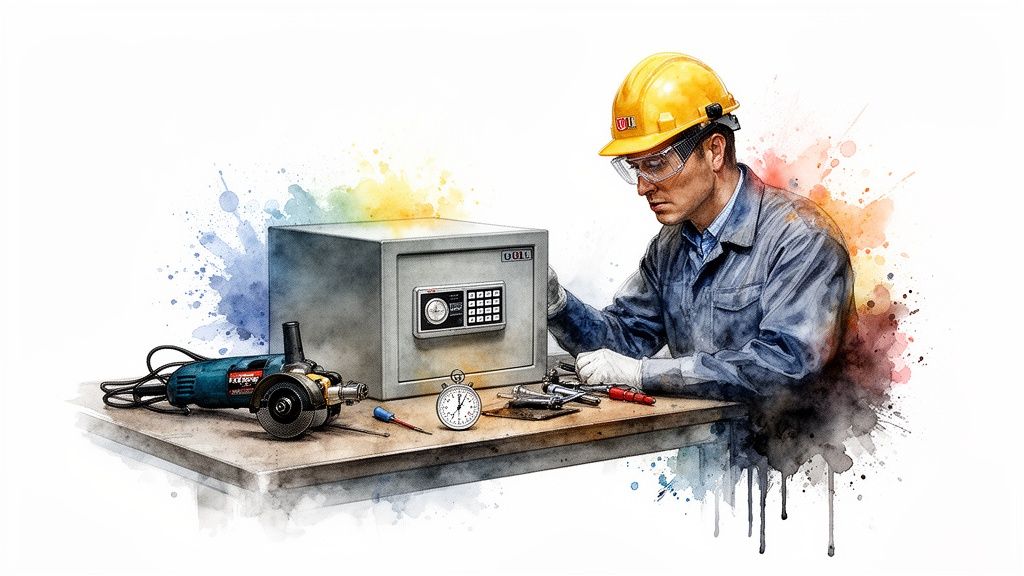 A technician in a hard hat and safety glasses works on repairing a safe with tools.
This all goes down inside a UL laboratory, where expert technicians have one job: get inside the safe as fast as possible. These aren't just guys with crowbars; they're seasoned pros who know the ins and outs of safe construction, lock mechanics, and material weak points. They know precisely where to drill, pry, or cut to do the most damage in the least amount of time.
The Art of the Attack
The moment the test starts, the clock starts ticking. But here’s the critical part: the test measures "net working time." This means if the technicians have to stop to swap out a drill bit, rethink their strategy, or let a tool cool down, the clock stops too. It only runs when a tool is actively in contact with the safe.
This is exactly why a rating like TL-15 is so impressive. It’s not 15 minutes of half-hearted effort. It’s 15 solid minutes of focused, expert destruction. For an average burglar, that could easily stretch into an hour or more of frustrating work.
The tools used aren't chosen at random, either. UL equips its team with a standardized arsenal designed to mirror what a well-prepared, sophisticated burglar would carry. This includes a mix of common and specialized gear.
- Hammers and Sledges: For raw, brute-force impact.
- Pry Bars and Wedges: To exploit any weakness in the door seams or frame.
- High-Speed Drills: Outfitted with carbide or diamond-tipped bits to chew through hardened steel plates.
- Power Saws and Grinders: For slicing through the safe's body or door.
A Century of Standardized Destruction
This intense, hands-on testing has a long history. Underwriters Laboratories became the go-to authority for safe security way back in 1923, when it conducted its very first burglary resistance test. Over the last century, UL has honed these evaluations into a science under its UL Standard 687, using the best testers to simulate real-world attacks.
A TL-15 rating, for example, means the safe held its ground for 15 minutes against a team of these experts. It's a benchmark that has become the gold standard for serious security. You can dig deeper into the history of these burglary ratings and test methods to see how they've evolved.
In the end, when a manufacturer earns a UL safe rating, it means they willingly sent their product into the ring for the toughest fight imaginable. It’s proof that their safe’s design can hold up against not just brute force, but a smart, calculated attack from professionals. That’s why a UL label is so much more than a sticker—it’s a verified promise of protection.
How to Verify a UL Rating and Spot Fakes
Just like you’d meticulously check a watch's serial number before buying it, you need to do the same for a safe's UL rating. A manufacturer's claim is just talk until it's independently verified. This simple check is what protects you from misleading marketing and ensures the security you're paying for is real—not just a sticker on a metal box.
The first step is always a hands-on, physical inspection. A genuinely certified safe will have an official UL Mark, which is much more than a simple label. This mark is usually a metallic plate or a tough foil sticker applied directly to the safe, often on the inside of the door. You're looking for the distinct UL logo, a file number, and the specific rating (like "TL-15 Burglary").
Use the Official UL Database
Physical labels can be faked. The ultimate source of truth is the official UL Product iQ database, a free online tool that lets you confirm any manufacturer's claim. Think of it as the central registry for all things UL-certified.
To verify a rating, you'll need the manufacturer’s name or, even better, the UL File Number from the label itself.
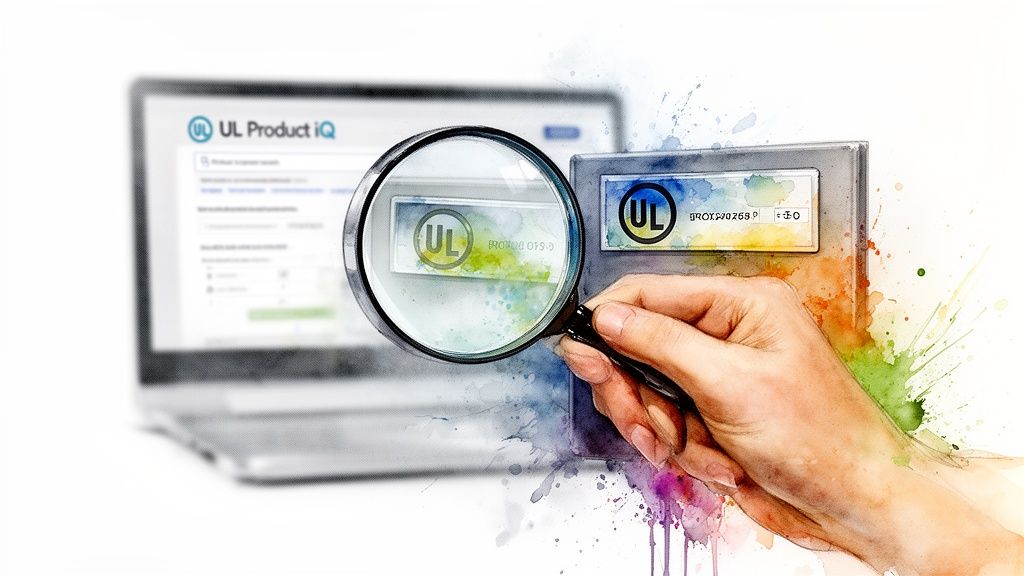 Verifying a UL product rating with a magnifying glass on a physical label and digital search.
This powerful tool lets you search by company name, keyword, or that unique UL File Number to see the exact certifications a product holds. If a safe doesn't show up in this database, it is not UL-certified, no matter what the marketing materials claim.
Spotting Red Flags and Misleading Language
Dishonest sellers often use clever wording to imply security that simply isn't there. Learning to spot these phrases is a crucial skill for any buyer.
The most common red flag is the phrase "built to UL standards" or "tested to UL specs." This language is intentionally deceptive. It means the manufacturer might have followed some of UL's guidelines, but they never actually submitted the safe for the grueling, independent third-party testing required for real certification.
Here are other common warning signs to look out for:
- Vague Claims: Phrases like "burglary-proof" or "theft-resistant" are marketing fluff without a specific, verifiable UL rating to back them up.
- In-House Testing: A "factory-tested" or "manufacturer-certified" rating is not a substitute for an independent UL evaluation. It's the fox guarding the henhouse.
- Missing File Number: A legitimate UL label will always have a specific file number you can look up. If it's missing, you should be very skeptical.
By combining a physical inspection of the UL Mark with a quick search in the Product iQ database, you can confidently validate any ul safe ratings. This simple, two-step process cuts through the noise and guarantees you're purchasing proven, certified protection for your most valuable assets.
Why Your Insurer Cares Deeply About UL Ratings
Picking a safe with a solid UL rating isn't just about peace of mind; it's a hard-nosed financial decision. To your insurance company, that safe isn't just a heavy box—it's a critical piece of their risk management puzzle. A genuine UL certification gives them a standardized, predictable benchmark for how well your valuables are protected, and that directly impacts your policy and what you pay for it.
Think about it from their side of the table. Their entire business is built on calculating risk. A generic metal safe from a big-box store is a total wild card. Will it hold up for a few minutes, or will a thief pop it open with a crowbar in 30 seconds? That level of uncertainty is a massive financial gamble when they're insuring something like a collection of high-end watches.
The Non-Negotiable Requirement for High-Value Collections
This is exactly why insurers don't guess. When you're talking about insuring a significant collection, they will almost always mandate a safe with a specific minimum UL burglary rating. This isn't a friendly suggestion—it’s a condition of the policy. They need proof that your safe can stand up to a professional attack for a known amount of time.
This requirement sets a clear, unambiguous standard. An underwriter looking at your policy might specify:
- TL-15 Rating: A common baseline for valuable collections, guaranteeing the safe can resist a skilled burglar with tools for at least 15 minutes of net working time.
- TL-30 Rating: For more substantial collections, this rating provides double the protection, giving the insurer confidence that your assets can survive a longer, more determined assault.
By demanding a specific ul safe ratings level, the insurer isn't just looking out for your stuff—they're protecting their own balance sheet. A certified safe dramatically lowers the odds of a successful theft, making your policy a much safer bet for them to take on.
The Financial Upside of Certified Security
Meeting your insurer's requirements does more than just secure your policy; it can actually save you money. When you install a properly rated safe, you're signaling to the insurance company that you're a responsible, proactive owner. They often reward this reduced risk with significantly lower annual premiums. Over a few years, these savings can be big enough to offset a good chunk of the safe's initial cost.
But here’s the most important part: having the right UL-rated safe ensures that if the worst happens, your claim gets paid. If your policy requires a TL-15 safe but you bought a cheaper, unrated model to save a few bucks, the insurance company could have grounds to deny your claim entirely. That would turn a bad situation into a catastrophic financial loss.
At the end of the day, a UL-rated safe does two jobs. It's a formidable physical barrier that buys precious time for law enforcement to respond to a break-in. And just as critically, it's the contractual bedrock of your insurance policy, ensuring the financial safety net you've been paying for is actually there when you need it most.
Common Questions About UL Safe Ratings
Even after you've done your homework on UL ratings, a few specific questions always seem to pop up when it's time to actually buy a safe. Let's tackle the most common points of confusion head-on so you can make your final decision with total confidence. Think of this as the last-minute gut check before you invest in your security.
We’ll clear up the difference between protecting against thieves versus protecting against fire, bust a few myths about price and security, and get into why installation is so critical. Getting these details right is just as important as picking the right rating in the first place.
What's the Difference Between a UL Burglary Rating and a Fire Rating?
This is easily the most important distinction to grasp. A UL burglary rating (like RSC or TL-15) and a UL fire rating are two completely different certifications for two completely different threats. They are not interchangeable, period.
- Burglary Rating: This is all about brute force. It measures how well a safe can resist a physical attack from tools like drills, grinders, and pry bars. If you're protecting valuables from theft, this is the rating that truly matters.
- Fire Rating: This test measures how long the safe’s interior can stay below a certain temperature—usually 350°F for paper documents—during a house fire. A safe can have an incredible fire rating but be a complete pushover for a burglar.
A safe without a specific UL burglary rating should never be trusted with high-value assets. It doesn't matter what it costs or how good its fire certification is; it was engineered to do a different job.
Is a More Expensive Safe Always More Secure?
Not at all. The single most reliable indicator of a safe's security is its official UL burglary rating, not the price tag. You could spend a fortune on a beautiful, unrated "luxury" safe that looks impressive but offers less real-world protection than a more affordable, properly certified TL-15 model.
Always, always prioritize the verified UL rating over looks or brand name. This way, you know you’re paying for proven performance, not just clever marketing. A great starting point is to ask your insurance provider what minimum rating they require for the value of your collection; they'll tell you exactly what you need.
How Much Does Installation Affect My Safe's Security?
Proper installation isn't just a good idea—it's absolutely essential for the safe's security to work as advertised. In fact, most UL burglary certifications, especially for TL-rated safes, are only valid if the safe is anchored to a concrete floor exactly as the manufacturer specifies.
An unanchored safe is a thief's best friend. If a burglar can just wheel the entire safe out of your house, they now have all the time in the world to break into it at their leisure.
- Anchoring: This stops the safe from being tipped over or hauled away.
- Location: Bolting it down in a corner makes it much harder for someone to get leverage on the sides with a pry bar.
- Professional Help: A pro ensures the bolts are set correctly and that the safe will perform just like it did in the lab.
Skipping the anchoring step basically invalidates the security rating and hands a massive advantage to any intruder. Professional installation is a small price to pay to ensure your safe actually does its job when you need it most.
Why Can't I Find My Safe on the UL Verification Website?
If a safe model doesn't show up in the official UL Product iQ database, you should proceed with extreme caution. First, double-check that you spelled the company name and the model number perfectly. If you've done that and it's still not there, the safe is almost certainly not UL certified.
Some manufacturers use carefully worded, misleading phrases to trick buyers. Be on high alert for claims like:
- "Built to UL specs"
- "Tested to UL standards"
- "Meets UL guidelines"
These phrases sound official, but they really mean the manufacturer may have mimicked some UL principles without ever submitting the safe for—or passing—the rigorous, independent third-party testing. The UL Product iQ database is the one and only source of truth for genuine ul safe ratings.
Protecting your collection starts with knowledge, but the next step is taking action. A robust safe is a critical layer of defense, but so is having a plan if the unthinkable happens. The StolenWatch database allows you to register your timepieces, creating a powerful deterrent and a clear path to recovery. Don't wait for a loss to happen—secure your assets today by registering them at https://stolenwatchx.com.
Related Articles
View all
Understanding Burglary Safe Ratings to Protect Your Valuables
Demystify burglary safe ratings. This guide explains UL, TL, and EN standards to help you choose the right high-security safe for your collection.

Check Titan Watch Serial Number: Verify It's Original
Learn how to check a Titan watch serial number to confirm it's original and hasn't been reported stolen. Step-by-step guide with location and verification tips.

How to Obtain a Certificate of Authenticity for a Watch
Learn how to obtain a certificate of authenticity for a watch, what documents matter, and why a stolen-watch check should come before any certificate request.